T. rex vs Megalodon, Spinosaurus & More: Who Wins?
We drop one T. rex into four fights against apex predators from other ages and score each survival from F to S.
T. rex survives all four because footing, not teeth, decides every fight.
Every NerdNature fightThe Prehistoric Sea Giant
Megalodon in the water; the T. rex only survives by reaching landT. rex vs Megalodon
The inlet is the shark's ground, and the Rex walks into it after a stranded whale. His skeleton is threaded with air spaces like a bird's. A 2018 study that put a digital T. rex in water found it floated. The deeper he wades, the less he weighs, and the less his feet grip. With no way to push off, he can't turn or charge.
Megalodon strikes from the side, because there's no room under him to attack from below. She goes for the leg. Fossil whale bones show megalodon bites clustered on the flippers: disable first, eat later. Her serrated teeth rake his thigh with a bite estimated at up to 182,000 newtons, roughly 41,000 lb of force and about three times his best. A square bite would have taken the leg.
Nobody has found a megalodon skeleton, because cartilage rarely fossilizes. We have teeth up to about 7 inches and some vertebrae, so size estimates swing widely. A 2022 3D model of a 52-foot shark came in at over 61 metric tons, about 68 US tons and roughly seven times the Rex. Whatever the exact size, she outweighs him and outbites him 3 to 1.
What saves him is the ebb tide. Every foot the water drops hands weight back to him, and weight is grip. His toes dig into a ridge of sand, and a planted Rex can put his whole neck behind a bite. He clamps her snout at 35,000 to 57,000 newtons, up to about 12,800 lb, the highest bite estimated for a land animal. That snout is packed with electrical sensors, which is why divers are told to hit a shark there. It buys him seconds, and he drags himself onto dry sand.
We score it a D. This was a fight the Rex never had a real chance to win, only to survive. She owns the water. He lives because he finds the one thing the ocean doesn't have, which is solid ground, and every foot of tide that falls is a foot she can't use.
The Ice Age Hunter
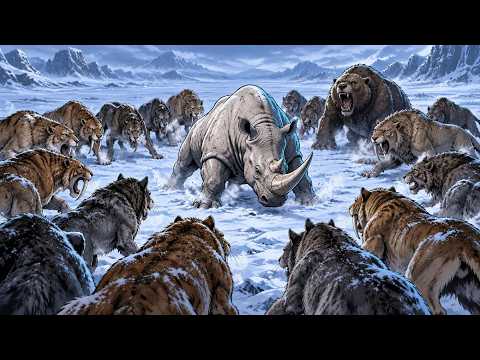
T. rex, slowly and at a costT. rex vs Smilodon pack
Smilodon isn't a tiger. It's its own branch of the cat family. Each cat runs 350 to 620 lb, so he outweighs them 30 to 50 times over. But x-rays show their forelimb bones were reinforced beyond any living cat, with a short tail and thick shoulders. They're built to grab something huge and hang on. Tooth chemistry from the La Brea tar pits says they hunted forest prey from cover, which is why they come out of the trees.
The first cat lands on his back and hooks her claws into the base of his neck, trying to pin him so the canines can slide in clean. Her problem is that modeling puts her bite at about a third of a lion's, and her skull handles a struggling target badly. Those 7-inch canines were called fragile for decades, and how well they worked on bone is still argued. Either way, a stab only works on a body that holds still.
The Rex does not hold still. His neck is thick cable muscle built to haul and tear meat. He drops a shoulder, whips his head sideways, and her grip tears loose. She tumbles across the frost, and one short crushing bite to her hindquarters ends her part in the fight.
The pack makes it hard. Three cats go for his legs, nipping the ankle and darting behind the knee to force him to shift weight on a thigh the shark already opened. He comes from a humid flood plain with no real winter, so every sharp turn in the cold costs him. To snap at cats that low he has to drop his head, which brings his throat to their level. That is the trap, but a lowered head is also a loaded one. A second cat leaps for his throat, and he catches her midair and slams her into frozen ground.
We score it a B. Against one cat he wins easily. Against a pack he wins slowly, and slow is dangerous. The last two cats back off because they've learned what the fight costs. He's still standing, but his thigh is bleeding again and bite marks line his legs.
The Mid-Cretaceous Rival
T. rexT. rex vs Spinosaurus
Spinosaurus is longer and lighter. She runs about 46 feet, 6 feet longer than he is, and weighs around 8 tons to his 9. In Jurassic Park III (2001), she snaps a Rex's neck. She opens with reach, snapping her narrow snout sideways across his face, then raking his flank with a hooked forearm claw. His own arms are about 3 feet long and reach nothing. But her cone-shaped teeth are made for gripping slippery fish, not crushing, and her claws hook rather than drive deep.
He lowers his head, bulls forward, and gets inside her swing. At that range her long jaws can't come around, and his close on her neck with the same 35,000 to 57,000 newton bite. She tears free, leaving flesh behind. The movie couldn't know what we know now. The original fossils were destroyed in a 1944 bombing raid on Munich, so scientists worked from photographs and scraps for decades. New fossils have redrawn her as a paddle-tailed swimmer with bones as dense as a penguin's.
That makes the river her home field. In the shallows her low, flat toe claws spread her weight across the mud, while his legs punch through into soft silt. Every step is a fight to pull a foot free, and she pounces on his slips. For a stretch it looks like the movie's ending. But power needs something firm to push against, and in mud every lunge he makes loses force before it lands.
So he stops lunging. He takes a gash across the ribs and backs up the bank. She follows because the river is home and she thinks he's retreating, and she doesn't notice the silt thinning under her feet. His heel strikes packed earth. He plants, locks his hips and swings his tail for balance. For the first time all fight he has a floor to push from. When she lunges again, his jaws come down across the back of her skull with nine tons behind them.
We score it an A. He survived her best ground, then dragged the fight onto his, and that takes judgment as well as strength. But he's bleeding from the face, flank and ribs, and a few more steps into that mud would have ended him. That's why it isn't an S.
The Modern Peak Predator
T. rexT. rex vs Saltwater crocodile
His own world prepared him for this one. Crocodilians lived in Hell Creek, the real T. rex's home turf in Montana, and they survived the asteroid that killed him. The river-ambush design has barely changed since the dinosaurs. A full-size saltwater croc is the largest reptile alive, with males past a ton and the record just over 20 feet. She crosses the gap in one burst of white water and locks her jaws on his lower leg before he can lift it.
The bite numbers are close. A big saltwater croc was measured at about 16,400 newtons, roughly 3,700 lb of force, the strongest bite ever measured in a living animal. Scaled to a 20-footer, the scientist who ran the tests estimates 7,700 lb, which is the low end of T. rex estimates. For once the Rex faces a bite in his own league. But her teeth are cones built to grip, not crush, and his shin is mostly bone and tendon under scaly skin.
Then she rolls. The death roll is built to shear meat off a carcass. She can't flip him, since he outweighs her six to eight times, but the roll still works on skin. Her teeth carve around his shin and peel scales away in strips, and his knee buckles for one second. That's the danger, because crocodiles kill big animals by holding on, dragging them into deep water and drowning them. If he goes down here, that plan works.
He doesn't go down. She can't drag nine tons into the river, so he drags her out of it. This is the third time he goes looking for solid ground. He hauls backward on the locked leg, step by step, until her body scrapes mud and her tail has nothing to push against. The riverbank becomes an anvil and his free foot the hammer. He stomps once, then again, nine tons coming down on her spine against packed mud. She slides back into the water and doesn't come up.
We score it an S. His hide didn't stop the bite, but his bones did, and his mass turned her best trick into nothing. Hold, drag, drown only works on prey that can be dragged. His leg is torn and bleeding, but it holds his full weight.
What it comes down to
The scores run D, B, A, S, and none of them turned on teeth. In every fight the T. rex did best with solid ground under his feet. Water floated him away from the ground and cost him against megalodon. Cold turns and a pack wore him down against Smilodon. Mud nearly beat him against Spinosaurus. Packed earth and nine tons beat the crocodile. The fight he couldn't win was the one where the ground ran out.
How we checked it
Every canon and real-world claim on this page was searched and read at the source before it went up. These are the pages we read.
- A buoyancy, balance and stability challenge to the hypothesis of a semi-aquatic Spinosaurus (Henderson 2018, PeerJ)2018 digital buoyancy models, including T. rex, floated; pneumatised skeleton with bird-like air sacs
- Megalodon shark - Save Our Seas FoundationMegalodon bite force 108,514-182,201 N, about three times T. rex
- New 3D model shows: Megalodon could eat prey the size of entire killer whales (phys.org)2022 model: 16 m (about 52 ft), over 61 metric tons
- T. Rex Could Pulverize Bones with a Force of Nearly 8,000 Pounds (Live Science)T. rex bite 35,000-57,000 N (7,868-12,814 lbf)
- Mega-Jaws: Donald Prothero on the Rise and Fall of the Giant SharkMegalodon bites on whale flipper bones used to disable prey
- Supermodeled sabercat, predatory behavior in Smilodon fatalis (PNAS)Smilodon bite one-third of a lion's; skull poorly suited to struggling prey
- Radiographs Reveal Exceptional Forelimb Strength in the Sabertooth Cat, Smilodon fatalisRadiographs show exceptional Smilodon forelimb strength
- Isotopic evidence of saber-tooth development, growth rate, and diet from the adult canine of Smilodon fatalis from Rancho La BreaLa Brea Smilodon preferred forest/woodland prey
- Meet 'Smilodon' - The Sabertooth Cat With A Bite Weaker Than A House Cat's (Forbes)Smilodon canines up to about 7 inches; PNAS bite-force result
- Megalodon (Monster Wiki)Largest megalodon tooth about 7 inches (17.8 cm)