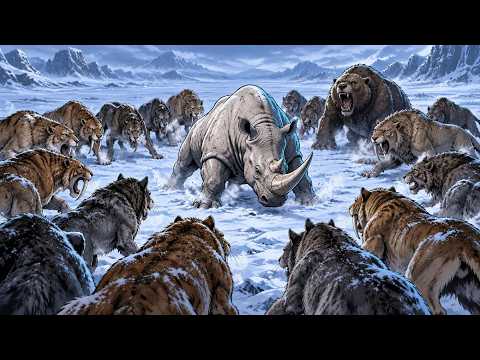
Godzilla vs Megalodon: Can Any Sea Monster Hurt Him?
Four real ocean giants, prehistoric and living, each fight the 393-foot King of the Monsters, and each earns a threat tier from F to S.
Nothing from Earth's oceans hurt Godzilla; the best result was a C.
Every NerdNature fightLivyatan, the whale that hunts whales
GodzillaLivyatan melvillei vs Godzilla
Livyatan is the right animal to send first. It was a sperm whale from about 9 million years ago, dug out of the Peruvian desert, with teeth up to 14.3 inches long. Those are the largest biting teeth of any known animal, tusks excluded. It rams Godzilla first, then goes for the seam where the neck meets the shoulder. That is exactly where a whale killer should bite.
The weak point is the tooth, not the jaw. Livyatan has no peer-reviewed bite force. The 100,000-plus newton figures online are blog math. What we can say is that dentine fails somewhere in the low hundreds of megapascals, so the tooth is the weakest link in the chain. The surface it loads is skin that walked out of Castle Bravo, the 15-megaton US hydrogen bomb test of 1954.
So the second bite lands clean in the seam, the jaw closes, and the tooth shears off at the root. It bites again and loses another. Godzilla wraps both hands around the lower jaw, tears it out sideways, and fires atomic breath point blank.
Mass settles it. Godzilla is 393 feet and 99,634 tons. Livyatan is about 60 tons, a ratio near 1,600 to 1. He doesn't bleed. All he carries away is a scuff and a broken tooth tip wedged in a plate seam. We score it F: the biggest teeth ever evolved never had a path in.
Megalodon, the apex ambusher
GodzillaMegalodon vs Godzilla
Start with the real size. The 2022 3D reconstruction put a mature megalodon at about 52 feet and 68 tons, cruising near 3 mph. That is well short of the oversized movie monster. It still has the strongest bite anyone has modeled, up to 182,000 newtons in published modeling. Its teeth were thick and built for grabbing prey and breaking bone, so it goes for bone at the tail base.
The bite never matters. The serrated teeth, over 7 inches long, rake down his scales and come apart. Sharks shed teeth constantly, so that costs the shark nothing, but nothing opens either. Godzilla can't see it in the murk, and his beam boils a long tube of water and hits nothing. The mass gap is 68 tons against 99,634, about 1,500 to 1.
What nearly costs him is the ground. He's standing on a sediment slope at the lip of a trench, and no trench was built to hold 99,634 tons. The mud shears and he rides the hillside down. At depth he's close to neutral in the water, with nothing to push against, and every 33 feet adds another 14.7 PSI. For about five seconds the King of the Monsters is cargo.
His fix is a handhold. He drives both hands through the mud to rock and stops, then lights every dorsal plate at once. The shark's gloom is gone. He takes it by the gills, slams it into the seabed and fires into the side of its head. In Godzilla vs. Kong he wrecks an aircraft carrier from the water, so the breath is no surface-only weapon and works submerged.
We score it E, one grade above Livyatan. Megalodon owns the hardest bite ever estimated, and the terrain nearly did its work for it. But the shark still never broke skin.
Basilosaurus and Dorodon, the Tethys pack
GodzillaBasilosaurus swarm vs Godzilla
Forty million years ago, in the warm Tethys Ocean, Basilosaurus grew up to 59 feet and about 7 tons. It had a crocodile-like skull on an eel-like body. Its name means king lizard because the 1834 describers took it for a marine reptile. Dorudon, a smaller dolphin-like whale, scatters in front of it. Our call is that the pack is a myth: the 2019 study of a Basilosaurus skeleton from Wadi Al Hitan found a Dorudon and several species of fish preserved as its prey, and bite marks on juvenile Dorudon skulls match its teeth. That points to a solitary predator raiding a nursery.
That makes the swarm worse for Godzilla in one way. Six uncoordinated predators still arrive from six directions, and his head points only one way. They hit the ankle, the flank and the calf with a bite estimated at no less than 16,400 newtons. Against him it's a fork on a battleship, and nothing opens.
Their best move is to stop biting the body and crowd his head. Three stack across his jaw, 20 feet from his mouth, each time the glow builds in his throat. He's in 200 feet of water with animals at his face, so a point-blank blast isn't clean. He also has no all-directions pulse. That belongs to burning Godzilla in King of the Monsters, after he absorbed a nuclear warhead and Mothra's energy.
So he goes still and lets all six press in inside 60 feet. Then he turns his head down and fires into the seabed. Water barely compresses, so the shock front carries a long way. Blast injury hits gas-to-water boundaries like lungs, sinuses and ears, and every animal there is an air-breathing mammal. The ones crowding him stop in the first instant. The ones that hung back swim away for good.
We score it D. The swarm died of the swarm, because clustering was the only tactic that worked and it put everyone inside one radius. Six animals, 42 tons total against 99,634, about 2,400 to 1, still got closer than the shark did. A 16,400-newton bite outranks a 182,000-newton one because the rank is about how close each came, not bite force.
The blue whale, the largest animal ever
GodzillaBlue whale vs Godzilla
The low note from the cold open was a blue whale. Blue whales produce some of the loudest, lowest-frequency calls of any animal, and they carry a very long way, so Godzilla could never locate it. He was standing inside the sound. The whale isn't hunting him at all. It's a baleen filter feeder with no teeth, running flat out from a noise it doesn't understand, and he's in its lane. This fight is in the bright upper water, not the deep.
It hits him at 22 mph with 219 tons behind it. But mass isn't damage; what counts is energy and momentum. The kinetic energy works out to about 9.6 megajoules, roughly 5 pounds of TNT, against Castle Bravo's 15 megatons. Spread across his mass, the whale changes his velocity by about eight-tenths of an inch per second. That's a push, not a hit.
The push lands at the one moment it counts. He's on the slope of the drop-off, nearly neutral in the water with nothing to brace on, the same problem the trench gave him. A body of 99,634 tons that starts moving in water doesn't stop. He slides. The whale comes around, shoulders him again, and the second hit adds to the first. For four seconds that's a real problem.
Then he quits fighting the whale. He drops into a crouch and drives his claws through the sediment into basalt, and the rock takes the load. The slide stops, the whale rolls over the top of him and keeps swimming, unscratched. He lets it go. It was never an opponent, it was weather.
We score it C, the highest of the day. It didn't hurt him. It's the only animal that moved his center of mass, and it did that by borrowing the one weapon the sea really has: no footing.
What it comes down to
C is the ceiling. Every animal in this ocean is a penetration weapon, and penetration is the one thing a 99,634-ton body makes irrelevant: teeth shear off and mass only pushes. All the sea left on him was one broken Livyatan tooth tip, which fell from a plate seam on his shoulder. The only thing that put him in trouble twice was the seafloor failing under his own weight. The ocean never beat him. His own mass came closest.
How we checked it
Every canon and real-world claim on this page was searched and read at the source before it went up. These are the pages we read.
- Livyatan - WikipediaTeeth 36.2 cm (14.3 in), largest biting teeth excluding tusks; Pisco Formation, Peruvian desert; about 8.9–9.9 million years ago; about 57 tonnes; the name Leviathan was preoccupied by a mastodon synonym
- Megalodon - Wikipedia2022 3D model: 16 m (52 ft), 61.56 t (67.86 short tons), cruising about 3.1 mph; bite force up to 108,500–182,200 N; teeth built for grabbing prey and breaking bone; teeth over 18 cm (7 in)
- Basilosaurus - WikipediaB. isis 49–59 ft and about 7.2 short tons; 'king lizard' from the reptile misconception, described 1834; bite force at least 16,400 N; Wadi El Hitan skeleton with Dorudon and fish (Voss et al. 2019); Dorudon a smaller dolphin-like relative
- Blue whale - WikipediaUp to about 98–100 ft and 190–200 t (210–220 short tons); burst swimming of 20–30 mph when threatened; among the loudest, lowest-frequency calls