Polar Bear vs Ice Age Animals: Who Wins and Why
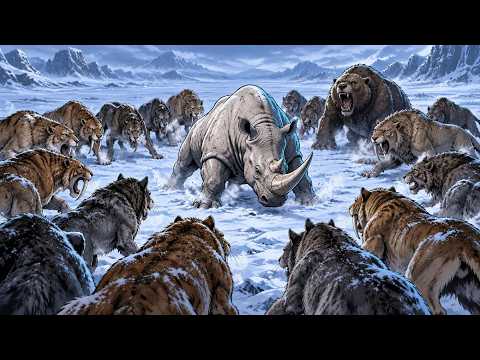
A polar bear steps off the sea ice into the Pleistocene and fights dire wolves, a mammoth bull, Smilodon and the short-faced bear, each scored F to S.
The polar bear survives the Ice Age, but only on ground it chooses.
Every NerdNature fightThe Wolf Pack
Polar bear (loses its seal)Polar bear vs dire wolf pack
Forget Game of Thrones. Real dire wolves weighed around 150 lb, comparable to big gray wolves alive today. A 2021 genetic study in Nature found they weren't even close cousins of gray wolves: the lineages split about 5.7 million years ago. Six wolves add up to roughly 900 lb, not far from the bear's own half ton, and that weight is spread across six sets of teeth.
On open ground the bear lands the first blow. The lead wolf lunges at its face and one paw, backed by the whole front half of the animal, folds it in midair. But a bear that hits that hard turns slowly. While it pivots toward the wolves in front, two more slip behind for the hamstrings. A 2005 study scored the dire wolf's bite about 20% stronger than a gray wolf's, size for size.
Every spin costs energy. A polar bear pushed past a brisk walk, a little over 3 mph, burns about twice the fuel per mile. The wolves don't have to win, they only have to keep it turning. So the bear backs up until cold rock is against its spine. With no behind left to guard, the wolves must come at the skull one at a time. Each charge costs them a body or a limb.
The pack does the math and takes the seal instead. The bear can't chase without giving up the rock, so it wins the fight and loses the meal, with a big hole in its energy stores. We score it a B. A polar bear can beat a pack when it picks its ground. On open tundra, a coordinated pack makes it pay in energy, and out here energy is the currency that matters.
The Giant Charge
Woolly mammoth herd (the bear escapes)Polar bear vs woolly mammoth bull and herd
The lone bull is real. When a 2017 study in Current Biology sexed mammoth remains by their DNA, 69% were male. Bulls roamed alone or in bachelor groups, took more risks and died more often in natural traps like bogs and lake ice. To a starving bear, a bull walking alone looks like a weak target. It's still a mistake.
A woolly mammoth bull was about the size of an African elephant: roughly 10 ft at the shoulder and up to 13,000 lb, more than ten times the bear. A big bull's tusks could pass 13 ft. The bull wheels faster than anything that size should, and the bear barely dodges a tusk that parts the fur along its ribs. The bear then bites the tendon above the back foot, the one fragile spot on a giant.
It doesn't matter. The bull's outer hair hangs nearly 3 ft long over an elephant-grade hide and up to 4 in of fat, so the bite comes away with a mouthful of wool. Then the herd crosses the river with trunks raised and tusks lowered, closing ranks to run off a predator near their calves. Everything about the bear's design is built to pull down prey and carry it off. Nothing in it answers a crowd of animals that each outweigh it ten to one.
The bear escapes on speed and on ice. Recorded elephant speeds top out around 15 mph and a polar bear can burst to 25. On thin ice it spreads its legs and drops its belly, putting half a ton across paws about a foot wide. Minnesota's ice guidelines call for 5 to 7 in to carry a snowmobile and 13 to 17 in for a truck. A bull weighs about as much as two pickups, so the herd stops at the edge.
We score it a D. The bear heard a mammoth but never came close to baiting one. Against mass this extreme, backed by a herd that fights as one, it survived only by leaving.
The Ambush
Polar bearPolar bear vs Smilodon
Smilodon wasn't a tiger. It was a separate branch of the cat family with no living members, and at 350 to 620 lb it was bulkier than a lion. The bear outweighs it nearly two to one. The sabers ran about 7 in and snapped more easily than any living cat's teeth. The jaw opened nearly 120°, almost double a lion's gape, but a 2007 computer model put the bite behind those fangs at about a third of a similar-sized lion's.
That weak bite is why the cat's real weapon is its four limbs. X-rays show thicker bone walls in its forelimbs than in most cats its size. It tackles, pins and holds, and only then bites. That's why it ambushes. The cat goes still in the rocks above the bison carcass while the bear, whose nose can find a seal beneath the snow, is lost in a hollow that reeks of cat.
The cat drops from the ridge onto the bear's back with claws deep and all four legs locked around the shoulders. For a second everything lines up for it. The bear throws itself over and half a ton lands on the cat's ribs against frozen ground. The grip breaks. The cat comes again for the neck. The first bite spends itself in up to 4.5 in of fat, and the second lands better. Then the cat makes its mistake. It holds on a heartbeat too long, and a bite that weak needs stillness.
The bear twists and clamps the cat's foreleg, the limb the whole ambush depends on, and the bone snaps. A cat with a broken forelimb can't pin anything, so it limps off and leaves its kill. We score it an A. The ambush nearly worked, but the bear's weight, fat and bite turned a precision weapon into a liability. A specialist needs the fight to go its way. The bear only needs to be hard to kill.
The Final Showdown
Polar bear (on thin ice)Polar bear vs short-faced bear
The short-faced bear is the one predator here that outweighs the polar bear two to one. It was close to a ton, the largest estimates top 2,100 lb, and a big male stood about 5 ft at the shoulder. Its old image as a long-legged, fast-running super predator was taken apart in a 2010 paper titled "Demythologizing Arctodus simus, the 'short-faced' long-legged and predaceous bear that never was." Its legs weren't unusually long and its skull looked like an omnivore's. Some researchers think it scavenged much of its meat. Think of a one-ton opportunist that follows a blood trail.
On solid ground the weight tells. The short-faced bear swings first, and the polar bear's 4.5 in of blubber soaks the blow like packed foam. The one-bite throat finish doesn't happen. A polar bear can kill a seal with a bite to the head, but a ton of bear won't go down to one. The short-faced bear has reach, twists free and clamps the polar bear's shoulder. Only the fat keeps the teeth off bone for ten long seconds. The polar bear is losing.
So it stops fighting the bear and starts fighting the ground. It backs onto young, elastic sea ice, the kind that bends before it breaks. Its paws work like snowshoes, padded with tiny bumps that grip like cleats, and it splays its legs and drops its belly to spread half a ton wide. The short-faced bear follows, standing tall on four feet with close to a ton on them. The ice bows, cracks and drops away, and it plunges chest deep into near-freezing seawater. It's the same physics that killed mammoth bulls on lake ice.
Now the polar bear is where it has hunted all its life: flat beside a hole in the ice, waiting for a head to come up. Each time the short-faced bear heaves onto the shelf, it meets teeth, face first. They're punishing bites, not killing ones. It finally smashes a channel back to thick shore ice and hauls out soaked and torn. As an opportunist, it sees no meal worth this and walks away up the glacier.
We score it a B, the same grade as the wolves and for the same reason. The polar bear won on ground it picked. On dry open ground, the short-faced bear's extra thousand pounds decides it. That would be a D if the polar bear could break away and an F if it couldn't.
What it comes down to
The polar bear survives the Ice Age, but its wins come from ground, not strength. It beats the wolves with rock at its back and beats the short-faced bear with thin ice under its paws. It only escapes the mammoth herd by outrunning it. Smilodon is the exception: the bear's weight, fat and bite beat the cat on solid ground. What nearly broke the bear was never one enemy. It was the cost of each fight stacked on the last.
How we checked it
Every canon and real-world claim on this page was searched and read at the source before it went up. These are the pages we read.
- Dire wolves were the last of an ancient New World canid lineage (Nature, 2021)Dire wolves split from living canids about 5.7 million years ago; around 68 kg
- The Dire Consequences of Specializing on Large Herbivores (cites Wroe et al. 2005)Dire wolf bite force quotient 163 vs 136 for the gray wolf (about 20% higher)
- Energetic costs of locomotion in bears: is plantigrade locomotion energetically economical? (NOAA repository)Cost of transport doubles at speeds of 5.4 km/h and above
- Genome-Based Sexing Provides Clues about Behavior and Social Structure in the Woolly Mammoth (Current Biology, 2017)69% of 98 sexed mammoth specimens were male; males more often caught in natural traps
- Minnesota DNR Recommended Minimum Ice Thickness poster5-7 in for a snowmobile, 13-17 in for a truck
- Woolly mammoth (life-on-our-planet wiki)Male shoulder height about 9-10 ft, up to 6 t; fat up to 10 cm; longest tusk 13.3 ft
- Woolly Mammoth Facts For Kids & Adults (activewild)Guard hairs up to 90 cm (35 in); males up to 6,000 kg
- Supermodeled sabercat, predatory behavior in Smilodon fatalis revealed by high-resolution 3D computer simulationSmilodon bite force one-third that of a comparable lion (2007)
- Radiographs Reveal Exceptional Forelimb Strength in the Sabertooth Cat, Smilodon fatalis (PLoS ONE)Thicker cortical bone in Smilodon forelimbs than similar-sized living cats
- Smilodon Quick Facts (Extinct Atlas)Saber about 17-18 cm (about 7 in); gape about 120°
- Demythologizing Arctodus simus (Journal of Vertebrate Paleontology, 2010)Not especially long-legged; not a fast-running super-predator; big omnivore with meat probably from scavenging