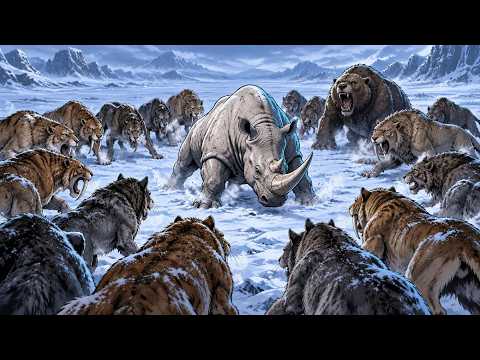
Woolly Mammoth vs 4 Predators: Who Wins and Why
A 13,000-pound Ice Age bull faces a tiger, a lioness, a brown bear and a crocodile in one day, and each attack gets a survival tier.
The crocodile is the only predator that puts the mammoth on the ground.
Every NerdNature fightThe tiger in the ambush
Woolly mammothWoolly mammoth vs tiger
The tiger does everything right. It hides in golden grass, and elephants, the mammoth's closest living relatives, are red-green color blind. If the mammoth was too, orange stripes barely show against gold. It creeps to about 20 yards, rushes, lands on the back and clamps the neck. That is the same move that finishes a deer or wild boar in seconds.
It fails because of thickness. A tiger's canines run about 3 inches, the longest of any living cat. The mammoth has a foot of hair, then thick skin, then up to 3 inches of fat. That is 3 inches of tooth against a foot of hair, thick skin and up to 3 inches of fat, so the bite never reaches muscle. The spine sits under a wall of neck muscle built to carry two heavy tusks that can run around 100 pounds each.
Then the mammoth drops its weight and whips sideways, flinging the tiger off the back. It lurches into a boulder and pins the cat's flank against the stone. The tiger hits the dirt with a hanging shoulder. The size gap decides the rest: a 500-pound tiger against a mammoth 26 times heavier. Gaur, wild cattle whose bulls reach about a ton, are the biggest animals tigers regularly kill, and even those kills skew young. Adult elephants are mostly left alone.
The mammoth is never in danger, hence the F. The tiger's real loss is the injury. Jim Corbett found old wounds on the man-eating tigers he hunted in India, like porcupine quills and bad gunshots, that kept them from catching normal prey. Tigers fail most hunts, with a commonly cited figure of roughly 19 in 20, so a bad shoulder can mean starvation.
The lioness on the open savanna
Woolly mammothWoolly mammoth vs lioness
A lone lioness has none of what makes lions dangerous. Lions win with numbers, a pride fanning out and pulling prey down from every side. She weighs about 280 pounds and hauls on an animal 46 times her weight. She hooks the rump the way lions take zebra and buffalo, rakes the hindquarters, and the mammoth does not even break stride.
Her sprint is the other problem. She can go roughly twice the elephant top speed of 15 mph, but only for a couple hundred yards. A lion's heart is about half a percent of its body weight, so every burst burns her out. The mammoth never has to run. It swerves each time she pulls alongside and walks her into the ground.
Heat is the one thing that helps her. This coat was built for brutal Ice Age winters, and elephants don't sweat. They shed heat through their ears, which make up about a fifth of an African elephant's skin. A mammoth's ears were small, based on frozen carcasses. The mammoth tires and its stride shortens. When she goes in for one more rake at the hind leg, it pivots and kicks her across the shoulder, sending her tumbling.
The real record shows why the tier is D. The Savuti lions of Botswana that kill elephants were a big pride hunting at night, mostly taking young elephants. For mammoths, the closest evidence is Yuka, a young mammoth from Siberian permafrost found in 2010 with claw marks some researchers pin on cave lions. Yuka was a juvenile of roughly six to eight years, not a 13,000-pound bull. The heat she forced on the mammoth is the only reason this isn't an F.
The brown bear in the pines
Woolly mammothWoolly mammoth vs brown bear
The bear is the one land predator that really overlaps with the mammoth. Of the four, brown bears are the only species that shared the Ice Age steppe with woolly mammoths, in Beringia, the land bridge between Siberia and Alaska. A crocodile never could have, because that steppe was far too cold for a cold-blooded reptile. He is also built differently from the cats: long claws that rip and pull, where cat claws pierce and hang on.
He charges downhill, rears up to full height and slams into the mammoth's shoulder. His strength is not what drops it. A 1,000-pound bear can fold a 13,000-pound animal only with help, and the help is the ground. The mammoth staggers sideways and plants its front foot on wet moss. The moss lets go, the knee buckles, and the bear climbs toward the head with his jaws in the shoulder fur.
The mammoth wins with its tusks, used as clubs, not spears. They curve too hard to stab. The curve hooks the bear under the ribs and the whole front end swings. A tusk is a lever, 6 or 7 feet of ivory with the neck behind it, so the farther out the bear sits, the faster the ivory hits him.
The trunk finishes it. The mammoth tucks its trunk against its chest, as elephants do in a real charge, because something got hold of that trunk once. A trunk can lift hundreds of pounds, so the curl pins the bear against the front leg. The next tusk swing makes something give in his shoulder, and he flees. Brown bears kill adult moose and the odd bison, and this was several times the size of a bull bison. The B: he got the first real hold on a leg, but he stayed outweighed and out-reached.
The crocodile in the river
Crocodile puts the mammoth on the ground; the mammoth escapesWoolly mammoth vs crocodile
This is the only fight where the mammoth's advantages stop working. It is overheated, bleeding and thirsty, so it wades into a warm river up to the knees. It does what it always does and lowers the trunk to drink, the habit we flagged in the first minute. A crocodile of 20 feet and over a ton erupts from the water and bites just below the knee of the front leg the bear already clawed. That is record size.
The grip is the first problem. The strongest bite ever measured came from a saltwater crocodile, and this animal is bigger. The mammoth's tusk sweeps through empty water and skids off a mud bank. Its free foot stomps into a soupy bottom and finds no purchase. Then comes the death roll. A crocodile can't chew, so it grips and spins until something tears loose.
On firm ground the mammoth's mass would anchor it. In soft mud, on a leg the bear already damaged, every ton presses down on a joint being wrenched sideways. The mammoth goes down on its side, the first time in four fights it has been on the ground. The croc lunges at the trunk and the old scar, the deadliest move of the day, because the trunk is how the mammoth breathes and elephants even use theirs as a snorkel. But the crocodile let go of the leg to do it. The mammoth jerks its head back and the teeth snap shut inches from the scar.
The mammoth then drags itself onto firm ground, and the real record backs the escape. In Zambia's South Luangwa National Park, a tourist photographed a Nile crocodile clamped onto an adult elephant's trunk, and the elephant hauled it out of the water. A fresh bull probably shrugs that off, but this one was on its fourth fight. That is the S: mass, footing and reach all stopped working the moment the mammoth stepped into that water.
What it comes down to
Each tier grades the danger to the mammoth, where F means it was never in danger and S means it nearly died. Tiger, lioness and bear all hit the same wall: too much mass, too much hide and fat, too much ivory. The bear came closest on land by using wet moss to drop a knee and by damaging that front leg. The crocodile didn't break the wall. It took away the ground the mammoth stood on, then went for the trunk it lowers to drink. The mammoth survives all four fights, and the crocodile earns the S for putting it down.
How we checked it
Every canon and real-world claim on this page was searched and read at the source before it went up. These are the pages we read.
- Can African elephants use leaf colour as a visual cue when making foraging decisions? (Animal Cognition)Elephants are dichromatic, i.e. red-green colour blind
- Detailed information on the characteristics of the tiger: Teeth and TongueTiger upper canines are the largest of the big cats, about 2.5 to 3 inches
- Woolly mammoth | BritannicaFat layer up to 8 cm (3 in) under extremely thick skin; outer hair over 70 cm long
- Yuka (mammoth) | WikipediaYuka was a juvenile found in 2010, about 6 to 8 years old
- 39,000-Year-Old Exquisitely Preserved Mammoth (IFLScience)Yuka found in 2010 in Siberia, aged six to nine, possibly preyed on by cave lions
- Jim Corbett | Military History WikiMan-eaters often had porcupine quills or unhealed gunshot wounds
- Hunting success | WikipediaTiger hunting success estimated at roughly 1 in 20 up to 1 in 2
- Gaur | Thai National ParksTigers hunt young or infirm gaur; healthy bulls weigh about 1000 kg
- How fast can an elephant run at top speed?Elephant top speed about 15 mph
- We Heart Animals: anatomical hearts of the animal kingdom (San Diego Zoo Wildlife Alliance)A lion's heart is only about 0.5 percent of body weight
- Why do elephants have such big ears? (Popular Science)African elephant ears make up about 20% of body surface area