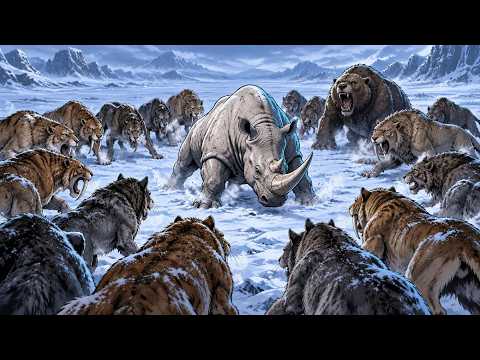
Swallowed Alive: Anaconda, Sperm Whale, Mosasaur, Croc
Mara Chen goes into an anaconda, a sperm whale, a Mosasaurus and a saltwater crocodile with a knife, a headlamp and a sixty-second breath hold.
Air and blood flow decide it, never acid: she survives only two of four.
Every NerdNature fightSwallowed by a green anaconda in the Amazon
Mara Chen survives; the anaconda drops herMara Chen vs Green Anaconda
A constrictor doesn't suffocate you. It cuts off your blood. In 2015 Scott Boback's team at Dickinson College wired up prey and measured it. Within 6 seconds, blood pressure in a leg artery fell by half. Your heart can't pump against that much outside pressure, so your brain stops getting blood. That's why Mara goes dizzy before she goes breathless. Her one useful move is jamming her left forearm under the second coil, so the loop has to close on bone stacked on bone. It buys time. It isn't an escape.
The knife does nothing, because a snake's lower jaw is two halves joined at the chin by a stretchy ligament. She stabs it and the anaconda doesn't flinch. Pain doesn't change the plan. Then comes the unsettling part. A 2012 Boback study in Biology Letters showed boas feel their prey's heartbeat through the coils and meter the squeeze against it. When Mara's pulse craters, the coils ease. The snake decides she's done and starts repositioning to swallow her head first, the way it takes a capybara.
Then the matchup breaks on size. A 2024 study of Burmese pythons up to 19 feet long measured a maximum gape of about 10 inches across, about 32 inches around. A woman's shoulders are wider. Her head goes in and one shoulder follows, but the other won't. No anaconda has ever been confirmed swallowing an adult human. The verified adult cases are reticulated pythons in Indonesia, beginning in 2017 and 2018, and in those the snake killed the person before the swallowing began.
The snake stalls with its jaws at full stretch and the ligament pulled thin. Mara gets about 4 seconds of blood flow back to her brain and spends all of them. The blade goes back into that ligament, loaded this time, and she rips upward. The jaw lets go. We score it a C because she didn't beat it. The mouth was half an inch too small, and the snake's own let-go instinct fired at exactly the wrong moment.
Swallowed by a sperm whale off the Azores
The sperm whale (Mara dies)Mara Chen vs Sperm Whale
The sperm whale is the one animal where the myth is older than the science. Jonah, Moby Dick and the 1891 story of a sailor cut alive from a whale's belly don't hold up, and no sperm whale has a documented case of swallowing a person. What's real is the anatomy. A large sperm whale's esophagus can be 30 to 40 centimeters (12 to 16 inches) across, wide enough that it's the only whale that could pass a person at all. That's the only reason the scenario is on the table. It's a suction feeder, and its teeth sit only in the narrow lower jaw. Mara is the right size by accident.
The first swallow tears her knife away. The first chamber isn't a stomach in the way you'd picture one. It's a muscular bag with no glands and no acid, built to grind food that was never chewed. The acid lives one door further on. Her lamp catches squid beaks, the leftovers a sperm whale brings back up. Then it catches silver. A pocket of air is trapped against the chamber roof, swallowed along with her. She takes the longest breath of her life. That window is real, because these whales rest at the surface 5 to 15 minutes between dives.
Then the whale sounds, and Boyle's law takes the room. Gas compresses with depth. At 2,000 feet, where these whales routinely work, pressure is about 60 times what it is at the surface. A pocket the size of a pillow shrinks to the size of a soda can, then to nothing. She doesn't freeze either. A warm-blooded whale holds a steady mammal body temperature at any depth. Nothing changes but the squeeze, and the walls clench in waves that push her down an inch for every inch she climbs.
The numbers close it. The whale is 45 minutes from air, and Mara was 60 seconds from hers when the pocket vanished. The deepest anyone has gone on one breath with every mechanical assist is 831 feet, set by Herbert Nitsch in 2012, a dive that left him with severe decompression sickness. Mara is more than 1,100 feet deeper than that, with no gas left to equalize anything. It's an F. She never reaches the acid. A routine dive crushed the only air in the room, and her one exit was open only while the whale was at the surface.
Swallowed by a Mosasaurus
The Mosasaurus (Mara dies)Mara Chen vs Mosasaurus hoffmannii
This is the real animal, not the Jurassic World one. That version is drawn far larger than the real animal, and paleontologists say it's too big. Real Mosasaurus hoffmannii was a good deal smaller, with length estimates that shift depending on which jaw fragment you scale from. It was still the biggest predator in its sea. It doesn't need to be a kaiju to swallow a person who's sitting on a driftwood raft.
What decides the fight is the roof of its mouth. Besides the row along the jaw, a second row sits on the palate. Those are pterygoid teeth, and researchers describe their job as gripping slippery prey and swallowing it without taking in seawater. Every one of them curves backward, so they slide one way and lock the other. Mara braces her boots against the palate and the teeth flex for half a second. Then each shove ratchets her deeper. Her struggling does the animal's work.
The throat then pins her elbow to her ribs before she can swing the knife. All she can manage is a twist a quarter inch at a time, which scratches a thin red line in muscle that just twitches. A cold-blooded gut would be slow, but a 2016 study by Harrell, Pérez-Huerta and Suarez ran oxygen isotopes on mosasaur teeth alongside fish, turtles and seabirds from the same rock. The results pointed to warm-blooded mosasaurs, so the chemistry in here runs at full speed.
The killer isn't the acid, which is a chamber away. Those palate teeth exist to keep seawater out of the swallow, which means the tube holds no water and no air. She tries to inhale on nothing and her last breath floats past her face as silver bubbles. One last drag of the blade skips across the lining, and the muscle closes over the cut. Her fingers open and the knife floats off. It's an F, and the opposite of the whale's F. The whale took her air and left her room to fight. The mosasaur took the room first, and the air was a formality.
The saltwater crocodile death roll
Mara Chen survives, badly hurtMara Chen vs 17-foot Saltwater Crocodile
A 17-foot saltwater crocodile takes her hip with the hardest bite ever directly measured on a living animal. Gregory Erickson's team got a 17-footer to clamp a sensor at 3,700 pounds of bite force. Then the whole animal rolls. The death roll isn't the kill, it's the butchery. A 17-footer twisting a 140-pound woman is well inside its envelope, so it doesn't risk its own jaw.
Mara survives because one bite isn't enough. Crocodiles can't chew. They swallow prey whole or tear it into pieces small enough to gulp. She's too big for the first, so the croc has to let go to set up the second. The jaws open between the second roll and the third. That gap is documented, and it's the whole reason this chapter isn't an F. Val Plumwood was death-rolled by a saltwater crocodile in Kakadu, was released, and survived.
Her hip slides off the teeth, and she wraps her left arm around the snout and clamps it shut. A crocodile's closing muscles are enormous and its opening muscles are weak. Handlers can keep a small animal's mouth shut with a rubber band. She owns the jaw for a moment, then drives her thumb into the eye socket and the roll breaks. The croc takes her leg instead and drags her toward the deep channel.
Underwater and out of air, she needs the mouth open, so she reaches past the teeth and the fixed tongue and hooks the palatal valve. That's the flap where the tongue and a throat fold seal together so the croc can open its jaws underwater without drowning. She tears it, and river water floods its airway. It still doesn't let go, because gagging isn't quitting. She drives the knife to the handle behind the jaw hinge, where bone gives way to muscle, and the jaw springs open. We score it a D. A mouth that can't chew handed her a half second, and a throat that has to seal handed her a target. That's the animal's design, not her skill.
What it comes down to
None of the four animals killed her with acid. Three of the runs came down to air: how much she had, and how fast the room holding it disappeared. The fourth, the anaconda, came down to blood flow, cut in half in 6 seconds. She walks away from the anaconda (C) and the crocodile (D) because of the animals' own limits: a mouth half an inch too small, a mouth that can't chew. The sperm whale (F) crushes her only air pocket at 2,000 feet, and the Mosasaurus (F) takes her room before her air. The animal with no interest in swallowing her came closest to killing her, and the two that swallowed her cleanly barely had to work.
How we checked it
Every canon and real-world claim on this page was searched and read at the source before it went up. These are the pages we read.
- Snake constriction rapidly induces circulatory arrest in rats - PubMedBoback 2015: within 6 s femoral arterial pressure fell to half of baseline
- Snakes Know When to Stop Squeezing Because They Sense the Heartbeats of Their PreyBoback (Dickinson College, 2012): boas sense prey heartbeat and ease off when it stops
- Pythons can swallow even bigger prey than scientists realized (EurekAlert)Study published Aug 2024 on 15-, 17- and 19-ft Burmese pythons; max gape 26 cm (10.2 in)
- WATCH: Burmese python swallows 77-pound deer (Yahoo/WFLA)10.2 in gape equals about 32 in circumference
- Death of Akbar Salubiro - WikipediaReticulated python cases in Indonesia: 2017, 2018, and later cases in 2022 and 2024
- Could a whale swallow a human, 'Whalefall' style? (Science Friday)No documented case of a sperm whale swallowing a human; esophagus up to 30-40 cm
- Sperm Whale (Alaska Dept. of Fish and Game)Dives routinely to 2,000 ft lasting up to 45 min; surface intervals 5 to 15 min
- Deepest no-limit freedive (male) - Guinness World RecordsNitsch reached 253 m (about 830 ft) on 6 June 2012, then suffered severe decompression sickness
- Australian saltwater crocodiles are world's most powerful biters (ScienceDaily)17-ft saltwater croc bite force of 3,700 pounds, the highest recorded
- Whale tales: Old and new (Hekint)The 1891 James Bartley whale-belly story is a fabrication