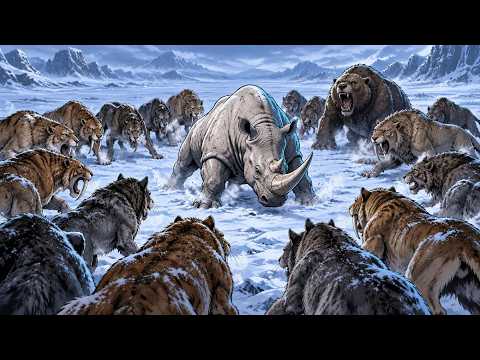
Neanderthal vs Every Bear: Who Wins and Why
One Neanderthal with a stone spear and a flint hand axe fights four bears back to back, and every wound he takes carries into the next fight.
One Neanderthal beats three bears and dies to the Kodiak: overall F.
Every NerdNature fightThe Black Bear
Neanderthal (the bear flees)Neanderthal vs American black bear
The Neanderthal is about 5'5" and 170 pounds, and he sees a 250-pound bear as a meal. His people hunt big game, and this animal is smaller than most of it. He walks at it with the spear low. That is the mistake. Most black bears run from people, but the ones that don't fit a type. In 110 years of fatal black bear attacks in North America, 88% were predatory, almost all by males. This is a big male.
The bear charges at about 30 mph and closes the gap before his thrust arrives. The point misses, and claws only about an inch and a half long rake his forearm from wrist to elbow. He can't dodge or outrun it. A 2004 study estimated that Neanderthal short legs cost about 30% more energy to move than modern human legs. His body is built to get close and hit hard, so he stops trying to avoid the bear.
On the second pass he plants his feet, tucks his shoulder and lets the bear come. He drives the spear in with both thick arms, and the point sinks deep into the bear's shoulder. The bear twists free and crashes off into the trees.
It earns a B because he won but paid for it. He underestimated an animal smaller than his usual prey, and the open forearm wound stays with him. The lesson is that speed beats confidence.
The Grizzly Bear
Neanderthal (the grizzly gives up and leaves)Neanderthal vs grizzly bear
The grizzly is close to 600 pounds, about three and a half times his weight. The shoulder hump is muscle for digging, and the claws run up to about 4 inches. It stands up, huffs, swats the ground and pops its jaws. Those are warnings, and he ignores them. When it charges at 20 mph, it hits with about 11,000 joules, roughly a motorcycle at the same speed. Holding his ground would take about 2,000 pounds of push. His hide-wrapped feet grip wet dirt with maybe 120.
So he skids 6 feet back through the leaves, and his build does its job. Thick-walled bones and a deep rib cage absorb a hit that could crack a modern man's ribs, and nothing breaks. Walking up and thrusting is also his real hunting method. Two deer bones from Neumark-Nord in Germany, about 120,000 years old, carry damage from wooden spears. Neanderthals hunted at arm's length.
The turn comes from a small cut. The grizzly's paw rakes across the flint point and its pad is sliced, so it flinches whenever it plants that paw. He kneels, sets the spear butt in the dirt and braces the shaft on his shoulder. The grizzly runs onto the point, and the flint bites into its chest. The spear has no crossbar, so the bear starts to shove up the shaft. He lets go and chops the foreleg above the cut paw with the hand axe, down to the bone.
It's a C because the grizzly shreds his shoulder and rips a gash across his side. The bear limps off on three good legs, but only because it decided he wasn't worth the trouble.
The Polar Bear
Neanderthal (the bear swims away)Neanderthal vs polar bear on the ice
On open ice with no cover, he is bleeding and leaving a trail of red dots. The polar bear is about 1,000 pounds, nearly six times him, and it stalks. Polar bears top out around 25 mph but overheat in a sprint, so they ambush instead. White bear in white snow, it erupts from a drift, and a paw the size of a dinner plate hits the ice where his head just was. The cold also favors the bear. It has up to 4 inches of fat and hollow guard hairs that trap heat and help it float, while he shivers and loses blood.
He tries to change the terms. He crosses thin ice over a frozen channel, staying low to spread his weight. It holds him. The bear does the same thing polar bears always do on thin ice: it spreads its legs and drops its belly. The ice breaks under it anyway, and that doesn't matter. This is Ursus maritimus, the sea bear, and one tracked female swam 426 miles in nine days through water between 35 and 42 degrees.
The bear goes under and surges up at the ice edge right below him. That is how polar bears hunt resting seals, and he is the seal. But for half a second its head and shoulders are out of the water and it can only climb. He drives the split spear into its face with all his weight, the same advice wildlife officials give today: fight back and go for the nose and face. Claws still tear his upper arm as the bear falls away.
The bear swims back and hauls out. Polar bears usually pass on healthy adult walruses because the risk of injury outweighs the meal, and a bear with a spear wound to the face has the same reason to quit. He lives, barely, with a shredded arm and an open side. It's a D, the shakiest grade on the board, because one thrust landed at the only moment it could.
The Kodiak Bear
Kodiak bearNeanderthal vs Kodiak bear
The Kodiak is the same species as the grizzly, Ursus arctos. It was cut off on Alaskan islands for about 12,000 years and grew huge on salmon. A large male runs up to 1,500 pounds, almost nine times him, stands over 10 feet on its hind legs and has huge claws. It isn't hungry. On Kodiak Island a bear injures a person about once every other year, so this one just wants him gone.
Every tool that worked before fails. His thrown spear glances off the skull. The hand axe, the trick that beat the grizzly, skids off fur and muscle and leaves a shallow line that doesn't bleed. One paw flips him through the air. Meanwhile none of his old wounds have closed, and blood loss has left his hands numb and his vision pulsing. A punch, a kick and an axe stuck in the ribs all land, and none of it matters.
His last gamble is a rocky ravine about 30 feet deep. He baits the bear toward the edge, then catches its front leg mid-step with his shoulder and heaves. One back foot slides toward the drop, but the bear plants its other hind leg and falls forward instead. All its weight lands on him, his ribs snap, and a paw presses his chest. He has no air left for the call his band would answer.
The F comes from the 9-to-1 weight gap. Thick bone and nerve can't close it, and nobody is there to keep him alive the way someone kept Shanidar 1 alive.
Verdict: Why the Band Mattered
Bears: he clears three and dies on the fourthNeanderthal vs the whole bear ladder
After the black bear, every bear outweighed him by more than 3 to 1, and every wound stayed open. The forearm cut, the torn shoulder, the side gash and the ripped upper arm all carried forward, so by the Kodiak he had almost no blood or strength left. What decided it wasn't brains or bravery. His body was built for grappling and holding heat, but it couldn't repair itself alone.
The Shanidar Cave skeleton in Iraq shows why. Shanidar 1 took a serious blow to the side of the face, lost his right forearm, walked with a limp, was probably deaf, and still lived into his 40s. The research doesn't say he healed faster than modern people. It says someone fed him and watched his back for years. That is the point about early humans: their toughness came from the band, not the bones.
What it comes down to
The Neanderthal is strong, dense and good at close-range fighting. He wins the first three rounds with a braced spear, a cut paw and one thrust to a polar bear's face. But each win leaves a wound no one tends, and the Kodiak's nine-to-one weight advantage lands on a body that is already failing. Alone, a Neanderthal was never the unit that mattered. The band was, and his wasn't there.
How we checked it
Every canon and real-world claim on this page was searched and read at the source before it went up. These are the pages we read.
- Beware of predatory male American black bears: Attack rates are rising with human population growth88% of fatal black bear attacks (1900-2009) were predatory; 92% of those bears were male
- The energetic cost of locomotion: humans and primates compared to generalized endothermsNeanderthal short limbs estimated at about 30% greater locomotor cost
- Neanderthals used refined hunting techniques 120,000 years ago - Leiden University120,000-year-old deer bones from Neumark-Nord, Germany, show spear impacts
- Older Neandertal survived with a little help from his friends - WashUShanidar 1: blow to face, right arm amputated at elbow, deaf, limp, lived into his 40s, relied on social support
- Polar bear tracked on epic 9-day swim - UPIFemale swam 426 miles in nine days through 35-42 F water
- Kodiak Brown Bear Fact Sheet - Alaska Department of Fish and GameUp to 1,500 lb, over 10 ft standing, isolated about 12,000 years, injures a person about every other year
- Bears of the Last Frontier ~ Polar Bear Fact Sheet - PBSPolar bears run up to 25 mph and move slowly to prevent overheating
- Polar bear - Wikipedia2-4 in fat layer, hollow guard hairs that trap heat and aid floating, ambush hunting, adult walruses too formidable
- Polar Bear Interaction Guidelines - U.S. Fish and Wildlife ServiceIf a polar bear attacks, fight back aiming at the nose and face
- Bears can run at surprisingly fast speeds - Popular ScienceGrizzly claws 2-4 in, black bear claws 1-2 in, grizzly top speed 35 mph