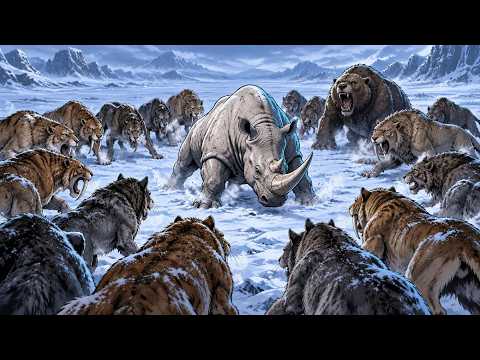
Modern Humans vs 4 Ancient Human Species: Who Wins?
A modern crew with spears, steel, shields and a fire kit crosses a valley of four extinct human species, each built by its fossils, before dusk.
Yes: the team walks out at A-, changing its plan every fight.
Every NerdNature fightHomo floresiensis: the hobbits in the reeds
The modern teamModern team vs Homo floresiensis
The reeds are where the team loses the early exchange. A river sits at their backs, and the thick cover funnels them down a corridor the hobbits chose. Rocks and stone flakes come from the left, the branches and the tree line. Long spears and steel blades swing at brush with nothing in it. One flake opens the thigh of a teammate, and that wound follows the crew all day.
The Floresiensis are small: about 3 feet tall, lightly built, with long arms and a brain of about 426 cc, roughly a third the size of ours. That is an island body. Food was thin on Flores, and a small frame burns little fuel, as the island's pygmy elephants showed. We also strip out the myth. A 2026 study of butchered bones in their cave found they mostly scavenged elephant-relative (Stegodon) carcasses that Komodo dragons had already picked over, with no sign of fire. So they get stone flakes and thrown rocks, not spears.
The fight turns on the foot. In the LB1 skeleton, the foot is about 70% as long as the thigh bone. Ours is about 54%. That is good for walking and bad for sprinting. When the team breaks out onto open flats, the hobbits charge slowly across bare ground into a line of spears longer than they are.
Mara plants her feet and sets the line. One attacker runs onto a point, another veers into a blade, and rocks bounce off planted shields because a thrower this small can't put much speed on a stone. About 30 seconds of open ground settles it. The reeds made the team pay first, which is why the tier is A-.
Neanderthals: the powerhouse on the ridge
The modern teamModern team vs Homo neanderthalensis
In the rocky pass the team is squeezed into single file, so one Neanderthal meets one man at a time with all his strength. He is shorter than the team but heavily built, with a barrel chest and a long thrusting spear as thick as a broom handle. He hits the front man like a falling tree, shreds a shield strap with one jab and folds a teammate with his grip.
The build is what is real. Short, heavy limbs keep his center of gravity low, and the power comes from that stocky frame. The blade that skips off his brow was about angle, not armor. The stooped brute comes from a 1911 reconstruction of one badly arthritic skeleton, and the 1957 re-examination showed it stood like us.
Mara's best call is to retreat downhill. A 2011 study found his short lower legs make him more adept on hills, so the ridge favors him and flat ground does not. On the gravel flat, two teammates drag the wounded man behind a boulder and the rest spread into a loose ring. When he charges, they scatter. When he turns, they are already elsewhere, and the spears start flying.
This is where the fight turns, on fuel. Some estimates put an active Neanderthal at 4,000 calories a day or more, and his short, heavy build has been estimated to cost about 30% more energy to move than ours. Each charge, only one human has to run. He runs every time. A gap he closed in two strides takes five. Then a spear sticks in his upper arm, another thumps his side, and he drops to one knee, 10 paces from the team. He limps back up the ridge. The humans won on range and stamina and paid with cracked ribs, so the tier is A-.
Homo heidelbergensis: the coordinated hunters
The modern teamModern team vs Homo heidelbergensis
These hunters are tall, clearly taller than the Neanderthal, and they carry long wooden spears. We tie them to the horse shoulder blade from Boxgrove, England, about half a million years old, whose hole is consistent with a spear wound. They do not charge. They spread into a line, and hand signals shift the whole line at once, pushing the team left toward a narrow gap between two rock walls.
We also correct a common error. The Schöningen spears of Germany are usually drawn in Heidelbergensis hands, but a 2025 redating moved them from about 300,000 to about 200,000 years ago, early Neanderthal territory. Heidelbergensis is also a messy name that experts debate. The danger here is not strength. It is a silent formation where each body covers the next.
Mara's answer is to break the shape. Two teammates dig shin-deep holes across the mouth of the gap, jam sharpened shafts in point up and cover them with grass. She lights a fire just behind the holes as bait. Whether Heidelbergensis could talk is unsettled, and it doesn't matter. The line moves in silence, so every order has to be seen.
The team's orders travel at the speed of a shout. They scatter on her call and snap back together before the hunters can read a gesture. The lead hunter sprints at the fire and two hunters drop onto the stakes. The line bunches and comes apart. One big hunter vaults the holes and cracks a shield, but Mara's blade and a spear behind his knee take him down. A trap doesn't only hurt a pack. It breaks what makes it dangerous, so this is the team's best tier, A.
Homo erectus: the endurance hunters and the grass fire
The modern teamModern team vs Homo erectus
The Erectus line walks and never runs. Their long legs and narrow frames are made to sweat and keep going, a design that lasted far longer than our species has existed. One leading theory says they hunted by persistence, as some modern hunters still do, following prey until it collapsed. They aren't trying to catch the team. They are trying to outlast it, as the sun sets.
We flip the old scene of cavemen fleeing flame. Erectus is the species most often credited with taming fire, from burned bone in a South African cave (Wonderwerk) first dated to about a million years ago, and a 2026 study pushes that as far back as 1.8 million. Fire doesn't scare them. But nobody has shown they could start one on demand. The oldest proof of fire making anywhere is about 400,000 years old and is credited to early Neanderthals.
That gap is the team's edge. Mara runs the ridge with a burning torch dragging low, and the dry grass catches in a line. The wind pushes the flames east toward the Erectus. In a stiff wind a grass fire's front advances steadily, too fast to cross, so you back away. The burn becomes a wall broken by one narrow lane, so the hunters must come single file.
One hunter finds the flank through the haze and slams into Mara. His hand clamps her wrist and a stone axe scrapes her ribs. She drives a knee up and twists, and a teammate's spear rakes his shoulder. He looks at the fire, looks at the team, and walks away. Persistence hunting works because the prey keeps running, so the hunters never fight it healthy. The team stopped running, on high ground behind fire, with the light going. It became a fight, which their method exists to avoid. Tier: A-.
What it comes down to
The team never out-muscled or out-ran any of the four. It scored A- overall because it changed its plan each time: long spears on open ground against the hobbits, range and stamina against the Neanderthal, a trap against the Heidelbergensis pack, and fire against Erectus. Each species arrived with one way to win. The humans had a playbook for four different fights, and none of the four ever needed one.
How we checked it
Every canon and real-world claim on this page was searched and read at the source before it went up. These are the pages we read.
- Ancient hobbit-like humans may have survived on meat left behind by Komodo dragons (Phys.org)2026 Science Advances study: H. floresiensis scavenged Stegodon carcasses Komodo dragons had used; no evidence of fire at Liang Bua
- The hominins of Flores: Insular adaptations of the lower body (ScienceDirect)LB1 about 1 m tall; foot about 70% of femur length vs 54% in modern humans
- Tiny brained Homo floresiensis shared common ancestor with humans (Royal Society)LB1 brain size 426 cc
- Solving the mysteries of short-legged Neandertals (ScienceDaily)2011 Higgins and Ruff study: short lower legs made Neandertals more adept on hills
- The effect of lower limb length on the energetic cost of locomotion (ScienceDirect)Neanderthal locomotor costs estimated about 30% higher than modern humans
- Boule Reconstructs the First Neanderthal Skeleton (EBSCO)Boule's bent-over reconstruction; Straus and Cave re-examined it in 1957
- First stone-tipped spear thrown earlier than thought (Colin Barras)500,000-year-old Boxgrove horse shoulder blade with a hole suggesting a spear
- World-famous Schöningen spears are 100,000 years younger than previously claimed (University of York)Schöningen spears revised to about 200,000 years old
- Earliest evidence of making fire (Nature)400,000-year-old fire-making evidence at Barnham, UK
- Traces of Homo erectus Fire Use Dated to 1.8 Million Years Ago (Archaeology Magazine)Wonderwerk Cave burned bone: earlier 1 million-year date, new 2026 dating 1.7-1.8 million years