Bull Moose vs Ice Age Predators: Who Wins and Why
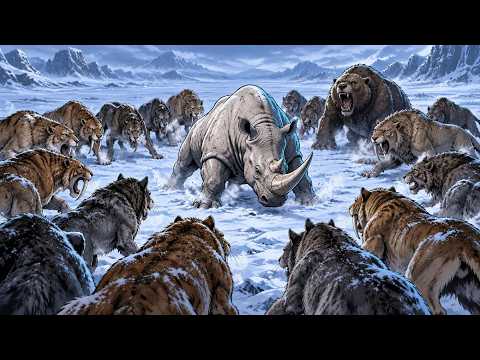
One bull moose faces dire wolves, a giant short-faced bear, Smilodon and American lions back to back, and every wound he takes carries into the next fight.
He survives three predators and loses to the lions on the fourth.
Every NerdNature fightThe Dire Wolf Pack
Bull mooseBull moose vs dire wolf pack
The bull wins by picking the ground. The wolves spread out to surround him, and open ground is a death sentence. So he turns to the river and stops knee deep. That is chest deep on a wolf, with a fast channel at his back. A wolf can swim that water, but it can't fight well from it. Now they can only come from the front and sides, and his stilt legs let him stride where they have to leap.
The first wolf to plunge in gets swept sideways off his antlers. The second goes low for the legs and takes a front hoof with a wet crack. Moose front hooves kill predators, and that wolf limps off for good. The pack then switches to a relay, one wolf darting in while another takes its place, and for a minute the tired bull pays for it. One wolf gets its teeth into his foreleg. He plants his hind legs against the current and stamps, and that wolf goes under the icy water.
Real moose and wolves play out this way. On Isle Royale in Lake Superior, David Mech's wolf study found one pack tested 77 moose and killed only six. Of the 36 that stood at bay until the wolves gave up, none were killed. The wolves here are soaked, shivering and slower, and every lunge has to come head on, one at a time. The leader stops on the bank. The hunt has stopped paying for itself.
One honest caveat: dire wolf fossils rarely turn up north of the 42nd parallel, and moose only reached North America about 11,000 to 14,000 years ago, so these two never really met. Real dire wolves also ran 130 to 150 lb, roughly the biggest gray wolves alive with a harder bite, not the giants of Game of Thrones. The bull outweighs each one six to ten times, which is why they need the pack. He walks away bleeding from the hindquarter wound and scores an A.
The Giant Short-Faced Bear
Bull mooseBull moose vs giant short-faced bear
The bear is the bigger, stronger animal. The largest topped 2,000 lb, and a big one standing up had a reach of about 14 feet. It also smells the blood trail the wolves left. It strikes first. The bull dodges behind a thick trunk as bark explodes where a paw landed. The spruce forest helps him, because the bear's long reach keeps catching on trunks that the bull slips through twice.
The forest is also a trap. The bull cuts around a spruce and his antlers wedge between two trunks. The bear rises onto its hind legs and draws back a huge forepaw. The bull drops to his knees and the paw slams into the tree above him. That buys one second, and he spends it twisting his skull free. The next swing catches his shoulder and tears through hide and muscle. He still drives his antlers into the bear's chest and shoves it back.
What decides the fight is the bear's skeleton. Researchers who study it say its joints weren't built for quick turns. A healthy moose can hit 35 mph, and one estimate puts this bear near 28. A chase through dense timber is nothing but turns. The bear clips a trunk on its first sharp cut and slows. A hard chase burns fuel fast, and a meat-only version of this bear would have needed a huge amount of flesh every day.
Burning that energy on a moose that keeps cutting corners is a bad trade, so the bear stops at a fallen log and lets him go. The bull gets out, but with a clawed-open shoulder. The short-faced bear is also a rewritten reputation: not a sprinting super predator or a thief of kills, but, on the leading view, a huge omnivore that ate meat when it could get it. It was built to cover distance, not to corner prey. We score it a C because the bull wins only by leaving.
The Smilodon Ambush
Bull mooseBull moose vs Smilodon
The bull walks onto an open plain with a ruined shoulder, and the cat is waiting in a snowdrift. Smilodon was an ambusher, not a chaser. A 2019 study of fossil teeth from the La Brea tar pits in Los Angeles found it preferred forest with cover over the open grassland of the old paintings. On this plain it has one hiding place, and it uses it. It lands on his neck before he sees it.
The cat's real weapon is its limbs. It is short, heavy and powerful, with forelimbs built thick for gripping. Four legs clamp around the neck while the jaws hunt for the soft spot under the jaw. Its gape opened past 110 degrees, against about 65 for a lion. But a 2007 computer model found its jaw muscles produced about a third of the bite force of a lion its size.
So the bull only has to break the grip. He whips his head, and a tine catches the cat's shoulder and pries upward. The hold slips and the jaws snap on air. The sabers are long, slender blades, and slender things snap. Big carnivores at La Brea broke teeth far more often than carnivores do today. The arms exist to hold prey still enough to protect those teeth, so a longer fight costs the cat more.
The bull finishes it with ground he finds. He drags the cat to a shallow slope glazed with ice. He plants his front hooves and pitches sideways, and the cat swings out like a pendulum. More than 1,000 lb of moose comes down on the ice, with the cat taking the crash underneath. Something cracks and it isn't the ice. The claws let go and one saber snaps off halfway down. A broken grip means the bite never lands. The cat may survive, since broken teeth were common among La Brea predators, but it won't eat today. He pays with a bloody neck, so it's a B.
The American Lion Pride
American lionsBull moose vs American lion pride
Here the ground stops saving him. At dusk the grassland holds a pride of American lions, bigger than any African lion. Their roar rolls across the steppe for miles. They don't charge. They arrange themselves, with some lions drifting to the flanks while others hold still. Field research on African lions backs this up: lionesses have been described splitting into wings that circle prey and centers that wait for it.
We can't prove ice age lions hunted as a team, since bones can't settle it. Art comes closer. A panel in France's Chauvet Cave, more than 30,000 years old, shows a group of cave lions, the American lion's close relatives, closing in on bison. Someone watched them hunt together and drew it. The bull is also the slowest animal here and the only one in the herd, and the first lion goes straight for the wolf wound on his hindquarter.
He fights hard. He rears and a tine rakes a leaping lion across the ribs. He backs onto a boulder as wide as a wagon, which covers his rump and forces the lions to come at the antlers, and two lions take hooves and limp off. But swinging that rack is like swinging a heavy door on a bad hinge, and his muscles are nearly empty. Each sweep comes slower, and the lions see it.
Then the light goes, and the dark is where lions are strongest. Studies of African lions find they hunt more successfully in darkness. The boulder covers his back and nothing else. Two lions come in on either side of the stone, and he can swing at only one. When he pivots off the rock to shake the left lion off his hindquarter, a third lion takes his throat. Lions kill big prey by suffocation, clamping the throat and holding on. A fresh bull might shake that hold, but this one has bled since dawn. His knees fold, and we score it an F.
What it comes down to
Three yes, four no. The bull's tiers are A, C, B and F. Three times the terrain saved him: a river that cut the wolves' angles, trees that exploited the bear's poor turning, and an ice slope that broke the saber-toothed cat's grip. But every win cost blood that he carried into the next fight. The lions were the first opponent with the numbers and the night to collect. He found good ground again, a boulder at his back, and had nothing left to hold it with.
How we checked it
Every canon and real-world claim on this page was searched and read at the source before it went up. These are the pages we read.
- The Wolves of Isle Royale (Summary), NPS Fauna Series 7Mech's pack tested 77 moose and killed 6; of 36 that stood at bay, none were killed
- Dire Wolves - White Sands National Park (NPS)Dire wolves weighed 130-150 lb, about 25% heavier than gray wolves, with a probably stronger bite
- Dire Wolf (Evansville)Dire wolf fossils are very rare north of 42 degrees N
- Southeast Alaska Moose: New Research, Alaska Dept of Fish and GameMoose crossed into North America shortly before the land bridge flooded about 11,000 years ago
- 14 000 years of moose in Arctic Alaska (Can. J. Zool.)Moose first colonized North America across the Bering Land Bridge ca. 14,000 years ago
- Moose - Rocky Mountain National Park (NPS)Moose can reach 35 mph
- Demythologizing Arctodus simus (J. Vertebrate Paleontology)Short-faced bear was likely a big omnivore, not a fast-running super-predator
- Arctodus (Extinct Animal wiki)One estimate puts Arctodus top speed at 25-28 mph
- Saber-tooth surprise: Fossils redraw picture of the fearsome big cat (National Geographic)2019 La Brea tooth study suggests Smilodon was a forest dweller
- Supermodeled sabercat, predatory behavior in Smilodon fatalis (PNAS 2007)Smilodon's jaw-muscle bite force was one-third that of a comparable lion