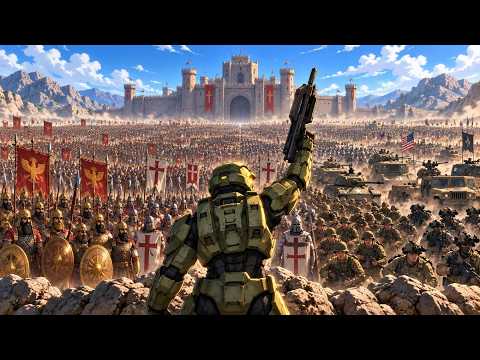
WW2 Armies vs Godzilla and Kaiju: Who Survives and Why
Four 1944 armies each face a MonsterVerse kaiju, and each is scored on how well it survives against what the monster has already shrugged off on screen.
No 1944 army could stop a kaiju; only the monsters could.
Every NerdHistory fightGodzilla vs the US Navy
GodzillaGodzilla vs US Navy Pacific Fleet
The Navy hits first and hits well. An Iowa-class battleship fires 16-inch armor-piercing shells, and each one weighs 2,700 lb. The destroyers add 5-inch guns and a spread of torpedoes. Nobody misses, and the shells burst across his chest like firecrackers. Godzilla barely turns his head.
The arithmetic settles it. Each shell leaves the barrel carrying about 356 million joules, roughly the energy of 190 lb of TNT. The MonsterVerse films count Godzilla at 90,000 tons. Even if a shell's full momentum went into him, he'd rock back less than half an inch per second. That is a pebble thrown at a bull.
The fleet does get his attention. His spines light blue from tail to neck, and a beam splits a destroyer in the middle. The water glows blue where it sinks, like Cherenkov light in a reactor cooling pool. The shock travels through the water, where sound moves more than four times faster than in air. It hits Ray's ship like a sledgehammer, kills the lights and injures the sonar operator.
The C tier comes from the gap between effort and effect. Ray's mast antenna survives and his radio keeps working. Godzilla loses interest and wades back out to open ocean. In the MonsterVerse timeline the US sets off Castle Bravo, a 15-megaton bomb, practically on top of him a decade later. That is about 180 million battleship shells at once, and he walks away. The fleet was an annoyance to him, never a battle.
Mothra vs the German Wehrmacht
MothraMothra vs German Wehrmacht Panzer column and Luftwaffe
The Panzers sit aimed at a cocoon in a wheat field in the Carpathians, and when it splits, Mothra's wings decide the fight. The gust throws a barn roof off and tumbles three Panzers over each other. A Panzer IV weighs about 28 tons, and shoving one sideways takes wind near 250 mph, which is top-of-the-scale tornado territory. The MonsterVerse never measures her wing wind. We borrow the 1964 Toho film, where her wing gusts knocked Godzilla off his feet.
The scales finish the column. They sift from her wings like golden dust, and engines cough and die where they settle. This is plain mechanics: engines breathe through air filters, and dust chokes the filters. Toho made the scales poison in 1964, the MonsterVerse dropped that, and ordinary dust is enough here. The flak also keeps missing. She is huge, so she looks slow, and every gunner is underleading her.
The Luftwaffe fares no better. A few dozen fighters get scraped together, and one wingbeat rolls the lead plane in her wake. A big wing's wake can roll a small plane harder than its controls can fight. The Germans do land one hit. A flak 88, which throws a 20-lb shell nearly 5 miles up, punches through her wing, and she drops for a long second. This part is our own call, since the films never test her against guns. She levels out, and three more wingbeats break the column.
The D tier reflects the one thing the Germans managed, which was to hurt her. Nothing in their arsenal could stop her. The mercy comes from her side. She flies around the village without costing a single roof a tile, while the tanks past the last fence burn in neat rows. Toho's Mothra is the monster who fights for people, and the MonsterVerse calls her a protector of humanity outright. The Germans survive only as far as she lets them.
Rodan vs the Imperial Japanese Army
RodanRodan vs Imperial Japanese Army
Speed decides this fight, and the first sign is the sound. Rodan covers a mile of sky every 3 seconds. Past the speed of sound, air can't get out of the way and piles into a shock wave. A shoreline garrison folds, trucks cartwheel, and windows burst down every street. Compare it with the strongest sonic boom on record, from an F-4 Phantom skimming the ground at 100 ft in 1967, at 144 lb per square foot, or 1 psi. Rodan's wings are over 20 times wider than a Phantom's, and bigger aircraft throw bigger booms. The 1956 original puts Rodan around Mount Aso, flattening Fukuoka.
The Army's guns are aimed wrong. The fighters are Ki-43 Hayabusas, not Zeros, which were a Navy plane. The Hayabusa tops out around 330 mph. In Godzilla: King of the Monsters, Rodan hunts down Monarch's modern fighter jets, far faster than anything the Army can put up. A shell takes 3 seconds to climb to him. In that time a fighter moves a quarter mile and Rodan moves a full mile. Every lead the gunners were taught is wrong. The shell bursts in empty sky and the fighters never get close.
Rodan's own attacks hit hard too. Monarch's profile puts the magma inside him at up to about 1,200°C (roughly 2,200°F), and it leaks from his wing tips as sparks. He skims a fuel depot and it goes up in a rolling orange blast. Ray and a Japanese interpreter outrun a wall of burning gasoline. Kong: Skull Island opens with an American and a Japanese pilot fighting until something bigger shows up.
The Army then does the smart thing. Hundreds of guns stop aiming and fill one stretch of sky with a curtain of steel too wide to dodge. It connects, and smoke swallows him for a second. He comes out screaming and without a mark. That follows the films. In King of the Monsters, the jets that fire missiles at him are the ones destroyed, and his rocklike scales act as armor. A shell of that size against that is the pebble and the bull again. He dives into the sea, finished with them. The Army had no real counter and no chance, so it scores an F.
King Ghidorah and Godzilla vs the Soviet Red Army
Godzilla and King Ghidorah, fighting each other; the Red Army never decided itKing Ghidorah and Godzilla vs Soviet Red Army in Moscow
Ghidorah arrives with a storm, and the Red Army throws everything at him. Katyushas scream off their rails, anti-aircraft batteries hammer the sky and thousands of riflemen fire as one. A full 16-rocket Katyusha salvo carries roughly one battleship shell's worth of explosive energy, and that is already known to do nothing to these monsters. Ghidorah drags a wing across his heads like a shield. He isn't wounded. He's annoyed.
His power draw and his beams show what the Red Army is facing. His middle head bites a power station and every street lamp in Moscow dies. He is drinking the grid. A gold bolt then tears a steel bridge apart. Measure it like lightning, which a steel structure such as the Empire State Building normally carries harmlessly to the ground. Ghidorah just cut a steel bridge in half.
The Soviets last longer than any other army, but only because Ghidorah hasn't decided they're worth killing. Then Ray feels the pulse in the rooftop and knows what's coming. Godzilla rises from the Moskva River, far too shallow to hide him. He doesn't hide in it, he comes up through it, since the later films have him traveling through underground realms beneath the Earth's surface. Ghidorah gets the edge at first, with three heads striking at once.
Godzilla wins the exchange, as he beat Ghidorah in Boston in King of the Monsters. He clamps his jaws on Ghidorah's middle neck and drags him backward into the river, because a flyer fights badly in water. The two vanish behind a curtain of steam while Moscow burns. The C tier credits the Red Army for keeping its guns firing longer than anyone, and it adds that only the monsters decided to fight.
What it comes down to
Across all four chapters, the point is that 1944 weapons spread their energy across bodies the size of city blocks. A 16-inch shell, a 20-lb flak round and a Katyusha salvo each fall short for the same reason the Navy's shells did. The one wound, Mothra's torn wing, changed nothing. The Navy and the Red Army scored C for their sheer firepower, the Wehrmacht got a D and the Imperial Japanese Army an F. The world survived because the monsters turned on each other, and the pulse Ray chased across the planet was the answer, never the threat.
How we checked it
Every canon and real-world claim on this page was searched and read at the source before it went up. These are the pages we read.
- 16-inch/50-caliber Mark 7 gun - WikipediaIowa-class 16-inch AP Mark 8 shell weighs 2,700 lb (1,225 kg)
- Why the Iowa-Class Battleships Were the Most Formidable of Their Time - The National Interest2,700-lb shell at 2,500 ft/s muzzle velocity (basis of the 356 MJ figure)
- Godzilla (Monsterverse) - WikizillaMonsterVerse Godzilla 90,000 tons (2014); Castle Bravo test aimed at him in 1954; beat Ghidorah in Boston
- Castle Bravo - WikipediaCastle Bravo yield was 15 megatons
- The speed of sound in water vs air - HyperTextbookSound is about four times faster in water than in air (not five-plus)
- Mothra vs. Godzilla - Wikizilla1964 Mothra uses wing-generated winds and a poisonous powder against Godzilla
- Mothra (Monsterverse) - WikizillaMonarch classifies Mothra as a protector
- 8.8 cm Flak 18/36/37/41 - Wikipedia88 mm flak: 20-lb shell, about 8,000 m (roughly 5 miles) effective ceiling
- Strongest measured sonic boom by an aircraft - Guinness World Records1967 F-4 Phantom boom of 144 lb per square foot
- Rodan (Monsterverse) - WikizillaRodan's wingspan about 265 m; in King of the Monsters he destroys the jets that fire missiles at him; rocklike scales