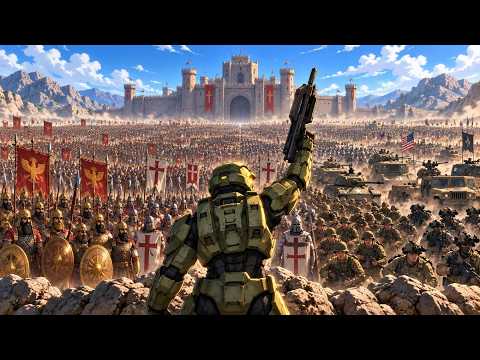
Medieval Europe vs Sauron's Army: Who Wins and Why
We drop knights, crossbows, castles and faith into the path of Mordor's host and grade four chapters, checking each call against Tolkien.
Europe wins one ford, then loses the war: tier F overall.
Every NerdHistory fightThe Black Tide Hits the Border
MordorHolland border knights and crossbowmen vs Mordor's orcs and Olog-hai
The knights do the right thing first. Forty horsemen, each horse and rider weighing more than half a ton behind one lance point, tear through the ragged orc line and the first wave breaks. That's what a heavy cavalry charge is for, and it works for a few minutes.
Then the Olog-hai arrive. These aren't the trolls from The Hobbit that turn to stone at dawn. In Tolkien, Sauron bred them late in the Third Age to endure sunlight, but only while his will holds them. They surpass even the largest Orcs in size and power, and Tolkien calls them harder than stone.
Plate armor is built to beat edges and points. A breastplate under a tenth of an inch thick spreads a sharp hit wide, but a hammer doesn't need to get through. A 50 lb stone swung at 35 mph carries about 2,800 joules, which is rifle-round territory, and it goes through the steel into the ribs behind it. That's why plate armor led to the warhammer. The horse folds and the rider flies 30 feet into a wall.
The arrows can't make up the gap. Wide hunting heads flatten against black iron or skid off. Orcs aren't arrow-proof (Legolas shoots them dead all through the books), but there are thousands of them and too few arrows find a gap. By sunrise Hollandbach is burned and every knight who charged is dead. The border falls in one night, so it's an F.
Europe Learns to Fight Back
Europe wins the river ford, but loses AenmarkAenmark's defenders and the Marshall's army vs the Nazgul and Mordor's host
At Aenmark the Nazgul come on fell beasts and scream, and men drop their spears, weep or run. That is straight from Tolkien: against men, the Nazgul mostly circle and cry, and terror is their weapon. Church bells and priests holding relics and torches steady the wall, but we don't claim the bells hurt the Nazgul. The books don't make a Latin prayer count.
What the books do give us is that the Nazgul dislike fire and fear those who wield it, so they stay outside the torchlight and peel away. The bells beat the fear, not the wraiths. Then rams and trolls hit the gate and wall, the lords can't agree on a plan, and the old marshal orders the city emptied, with granaries burned, wells fouled and bridges cut.
At the ford, Aldric's bolts decide it. A heavy medieval crossbow pulls around 1,200 lb and throws a bolt at about 150 mph with roughly 200 joules. Penetration figures based on Alan Williams' tests put about 175 joules to punch through 2 mm of mild steel plate (under a tenth of an inch) head-on. That 25-joule margin is the whole fight, and a soft head would waste it by flattening. A hardened four-sided steel head (the quarrel) spends it going through.
The bolts go through the black iron and the orc front thins. The first troll's hide still turns a bolt aside, because Olog-hai are harder than stone. So Aldric aims for the one soft spot he can see, and the second bolt goes in through the eye socket. The troll sways and goes down. The film kills its Moria troll on the same logic with an arrow through the mouth, while in the book Boromir's sword rings off the troll's arm and comes away notched.
The orc charge breaks at the ford, and that is Europe's only clean win. It still costs a city and leaves a trail of refugees, and it buys about three days. We give it a D.
The Dark Lord Adapts
MordorRavenholt's garrison vs Mordor's tunnelers, siege towers and trolls
Ravenholt is the best ground Europe gets: a fortress on a rock spur, 40-foot walls and one steep road to the gate. Walls on solid rock were far harder for human miners to undermine. The defenders use everything the fortress was built for: crossbows, stone throwers, pitch, fire arrows, and boiling water at 212°F followed by hot sand. (Not oil, which was expensive and rarely poured off a wall.)
It works. Trolls carry oak doors as shields, but fire catches the pitch-soaked ladders and burning orcs fall back through their own ranks. The wall holds for a full day and thousands of orcs die on the slope. That is why this chapter scores higher than the border and the ford.
The weakness is the tunnels. In The Hobbit, Tolkien says goblins can tunnel and mine as well as any but the most skilled dwarves. Those tunnelers never go under the wall. They go through the spur, and an orc squad led by a Nazgul comes up inside the city and splinters the north gate's bar. Rock only slows human miners.
The dead don't matter, because Mordor's host runs on Sauron's will, the same will that keeps the Olog-hai upright in daylight. One band can break, as at the ford, but the host doesn't. When the Witch-king dies at the Pelennor Fields, his lieutenant takes over. Gandalf says victory can't be won by arms. Europe holds a day, kills more than any army before it, and still loses the fortress at dusk. That is a C.
Sauron's Final Move
SauronThe last army of Christendom vs Sauron and the full host of Mordor
Outside Reims the combined kings and dukes do well at first. The cavalry charge hits hard and trolls drop one at a time with bolts in the eye, because Aldric's trick has spread to every crossbow company. The line holds for a moment. This is the best Europe plays all war.
Then Sauron walks out. We bend the canon on purpose here. In the books, the last time he fights in person is at the end of the Second Age, wearing the Ring. Elendil and Gil-galad die throwing him down, and Isildur cuts the Ring from his hand and keeps it, which is the only reason Sauron comes back. In this war he has the Ring again, the prize Gandalf warns he is desperate to recover to restore his power. Tolkien gives him a hand that burns like fire and the movie gives him a mace, and we use both.
French knights charge him with lances down, the move that broke the orcs an hour earlier. One mace swing and a dozen men leave their saddles, as in the movie's opening. Aldric's bolt at the visor sparks off the helm and Sauron doesn't turn his head.
The deciding weapon is dread. The Nazgul are his slaves and their terror was always his. Tolkien writes that few, even among the great of Elves and Men, could endure the malice of his eye. These are farmers and knights. They drop their swords before he reaches them and the line comes apart, with the lilies of France, the imperial eagle and the red cross of Burgundy falling in turn. Europe has no free kingdom left, so it's an F.
What it comes down to
Europe can win fights. Hardened bolts drop trolls, knights break orc lines, and rock walls and boiling water kill thousands. But Mordor's host runs on Sauron's will, so killing captains and winning battles doesn't end it. While the Ring exists, Sauron doesn't stay beaten, and Europe's last army breaks before him. That is why the whole war scores an F.
How we checked it
Every canon and real-world claim on this page was searched and read at the source before it went up. These are the pages we read.
- Orcs / Goblins thread (quotes Appendix F on Trolls) - Planet TolkienOlog-hai surpass the largest Orcs in size and power, are harder than stone, endure the Sun only while Sauron's will holds them
- Battle of the Chamber of Mazarbul - Tolkien GatewayIn the book Boromir's sword rang off the cave-troll's arm and came away notched
- The Hobbit Reread: Chapter 4, Over Hill and Under Hill - ReactorGoblins can tunnel and mine as well as any but the most skilled dwarves
- Last debate of the Captains of the West - Henneth AnnunGandalf: victory cannot be achieved by arms
- Gothmog on the Pellenor Fields - The Tolkien ForumGothmog, lieutenant of Morgul, takes command after the Witch-king falls
- Eye of Sauron - Tolkien GatewayFew even of the great among Elves and Men could endure the malice of Sauron's Eye
- Elendil - WikipediaElendil and Gil-galad die fighting Sauron; Isildur cuts the Ring from his hand and takes it
- The Boiling Oil Myth - Aurel StratanDefenders used boiling water and hot sand; oil was expensive and rarely used
- Battle of Crecy - could the crossbows have matched the range of the longbows - TWCenter1,200 lb composite crossbow: about 200 J and 70 m/s (~157 mph)
- Crossbow penetration thread - MyArmouryAbout 175 J needed for 2 mm mild steel plate, per Williams' figures