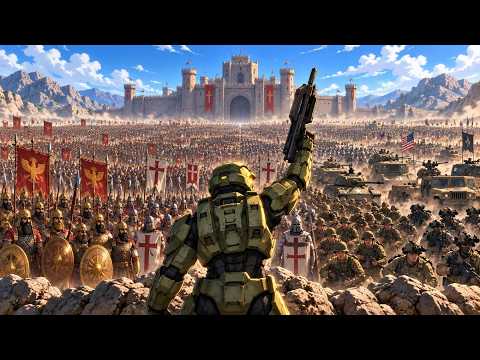
Modern Battalion vs 4 Ancient Walls: Who Wins and Why
A 600-man US Army battalion with 2,000 pounds of explosive, no tanks, no aircraft and no resupply tries to break four of history's most famous walls.
425 of 600 soldiers walk out, but only by spending every pound of explosive.
Every NerdHistory fightThe Great Wall of China: Jiayuguan Pass
Battalion breaks through, at a cost of 40 soldiersUS Army battalion vs Ming frontier garrison at Jiayuguan (1540)
The deciding rule is the breaching formula set up before the first shot. Double a wall's thickness and breaking it takes eight times the explosive. A charge laid against the wall with nothing packed around it needs nearly twice the explosive of one packed in tight. So the battalion never attacks thick wall. It hits the wooden gate, because every other way in would eat explosive it needs for three more walls.
The gate falls to one 20-lb satchel charge, and that is where the cost starts. Behind it is the urn city (Wang Chang), a walled courtyard with parapets on every side. Arrows and hand cannon shot come from all four walls. A crossbow bolt goes through a forearm and a hand cannon ball shatters a knee. Twenty-two soldiers fall in about 4 minutes, and the battalion pulls back, smoking the urn and mortaring the parapets.
The call that settles the fight is the walk north. The battalion could blow the inner gate and feed in another company, or march about 5 miles in 10-degree wind to where the wing wall meets the Black Mountains. It walks. The wall there is about 20 feet high, and the seam between packed earth and bare rock is a weak point. Engineers pack 280 pounds into it, with frozen dirt tamped around every block. The blast drops a slab into the pass and leaves a gap barely wider than a truck.
The final tally is 40 down: 22 in the urn, the rest to frostbite and arrows. That leaves 560 soldiers and 1,700 pounds of explosive. We score it tier C because the cheapest door on the wall still cost 22 lives, and the walk north cost hours of cold on top of that.
The walls of Constantinople
Battalion breaches the wall and holds the gapUS Army battalion vs the Theodosian land walls (c. 1000)
The land walls come in three layers. First is a moat about 65 feet across with a low battlement. Behind it is a wall nearly 30 feet high, then the main wall, 40 feet of stone with towers. The inner wall is built taller so its archers can shoot over the outer one onto the terrace between them. Arrows skip off helmets and plates, but the ones that find arms, necks and faces still hurt.
The mortars show why modern firepower does not equal wall-breaking power. An 81 mm shell carries about a pound and a half of explosive and is built to kill people in the open. Against fitted limestone banded with red brick and packed with mortared rubble at least 15 feet thick, it leaves chips and scorch marks. The breaching formula puts one hole, with the charge hung on the face, at more than 1,200 pounds of plastic explosive. The battalion has 1,700.
The real Constantinople gives two lessons. In 1453 Mehmed II's giant cannon did knock holes in these walls. But the bombardment ran about 7 weeks, and each night the defenders plugged the breaches with timber, earth and rubble. Mehmed also aimed his main assault at the Lycus Valley, where the wall drops into low ground. So the battalion hits the Lycus Valley and plans to go through before anyone can plug the hole.
Our call is fast over cheap. Boring holes and packing shape charges inside would cost several times less explosive, but it means an hour in the open between the walls. Hanging 1,300 pounds on the face and blowing it takes 5 minutes. Both walls fold and a company goes in. The gap is only a few yards wide, so the garrison can only come a few men at a time, and a dozen rifles can hold it. The total is 100 down, 500 through and 400 pounds left, and the tier rises from C to B.
The walls of Babylon: the Ishtar Gate
Battalion gets through the gate, but loses its mortars and almost all its explosiveUS Army battalion vs Nebuchadnezzar's Babylon (c. 570 BC)
Noon, heat and water decide Babylon, not stone. It is 112 degrees. Army water doctrine caps drinking at a quart and a half an hour, and each soldier carries about three quarts. The inner wall alone is about 21 feet thick, with an outer wall about 13 feet thick in front of it, so 400 pounds of explosive cannot touch them. The only target is the Ishtar Gate and the processional way behind it, a walled avenue lined with glazed lions and parapets. Waiting for dark means six more hours in the heat on the same water, so the commander goes at noon.
The gate itself is easy. Two satchel charges, 40 pounds, take the cedar doors Nebuchadnezzar's inscription brags about. But the corridor under archers and slingers is already costing men to heat stroke, and we blame the noon decision for that. Corporals sway and fold onto the bricks before a single charge is even hung.
The deciding blow is water. The mortar platoon sets up in a dry irrigation canal, the only cover on the plain, with the reserve explosives stacked beside the tubes. Nebuchadnezzar's own inscription says he set the gate's foundation down at the water table, and his officers know every canal. About 40 minutes after the platoon settles in, the Babylonians open a sluice. The water rises to waist deep, then chest deep, then over the base plates. Every mortar tube and 350 pounds of explosive go under.
The climbing rope earns its weight for the first time. A staff sergeant gets one end across and soldiers haul mortarmen out hand over hand, though not all of them. Silt jams rifles, and the explosive budget drops to 10 pounds, eight blocks in one engineer's pack. The battalion goes through the gate anyway, soaked, with 160 down in total and ammunition at about a third. The tier falls from B to D, and nothing is left that can break a wall.
The walls of Troy
Battalion gets in over the west wall; a six-man climbing team opens the gateUS Army battalion vs the citadel of Troy (c. 1250 BC)
The battalion arrives with 440 soldiers, low ammunition, no mortars and 10 pounds of explosive. The citadel wall is limestone about 16 feet thick, with a face that leans back, about 20 feet of stone and roughly 10 more feet of wall straight up on top. You don't need the formula here: 10 pounds against 16 feet of stone does nothing. So the battalion stops trying to break the wall and sends six men to climb it.
Where they climb comes from the Iliad. Hector's wife Andromache tells him to post his men by the fig tree, where the city is easiest to scale and the wall is weakest. In the 1890s Wilhelm Dörpfeld found the worst masonry on the circuit on the west side: small, rough, unworked stones. Nobody can prove that is the stretch she meant. But rough stone means finger and toe holds, and the team goes west.
The last 10 pounds of explosive is a decoy. On the east side the battalion fires machine guns at the parapet, rolls smoke across the slope and sets off the charge, which barely marks the stone. Every defender turns east. On the west the face leans back just enough and the wall steps back every 30 feet or so in a sharp vertical corner. The Iliad has Patroclus try one of those corners three times before Apollo throws him off. The team lead gets up the stone in about 4 minutes.
The upper wall is where the rope pays off a second time. The first grappling hook skitters off and clangs. The second bites, and the team lead goes up the knotted rope with five soldiers behind him. They fight bronze spearheads in a lane so narrow their shoulders touch both walls, and three of the six die. The survivors, helped by a wounded sergeant, push the waist-thick timber bar. It slides, and the battalion walks in. 425 of 600 survive, so the tier jumps from D to B.
What it comes down to
Each wall beats the battalion in a different way. The Great Wall wins with a killing floor, Constantinople with stone thick enough to make explosive the limit, Babylon with heat and water, and Troy with a poem's weak point that no charge can replace. The explosive runs out by Troy, so the battalion survives on judgment: tamping a seam, hitting the Lycus Valley, and climbing the rough west wall with a six-man team. We score only how many walk out. 175 don't, and 425 do.
How we checked it
Every canon and real-world claim on this page was searched and read at the source before it went up. These are the pages we read.
- Walls of Constantinople - World History EduInner wall about 12 m (40 ft), outer wall 8.5 m (about 28 ft), moat 20 m (about 65 ft) wide
- Fall of Constantinople 1453: Date, Siege Timeline, Forces and AftermathSiege of about 53 days; defenders repaired breaches night after night; fighting around the Lycus valley
- FM 23-90 Chptr 4 81-mm Mortar, M25281 mm HE round holds about 1.5 lb of RDX/TNT explosive
- Heat Can Kill You (army.mil)Army water doctrine: no more than 1.5 quarts per hour
- Nebuchadnezzar II 002 (Oracc RIBo)Inscription: foundation set at the water table with bitumen and baked brick; cedar doors faced with bronze
- How Babylon Used Double Walls and Moats to Deter InvadersInner wall about 6.5 m (21 ft) thick, outer wall about 4 m (13 ft)
- Troy (Britannica)Troy VI limestone walls about 15 ft thick at base, more than 17 ft high, with brick ramparts
- Mycenaean Troy / The Mycenaean City (Dörpfeld)Poorest masonry at Troy VI is the west wall, small unwrought stones
- Homer - The Iliad: Scroll 6, Hector & AndromacheAndromache tells Hector to post the host by the fig tree where the wall is weakest
- Homer, Iliad: Book 16 (e-text)Patroclus three times tried to climb a corner of the high wall; Apollo shoved him back