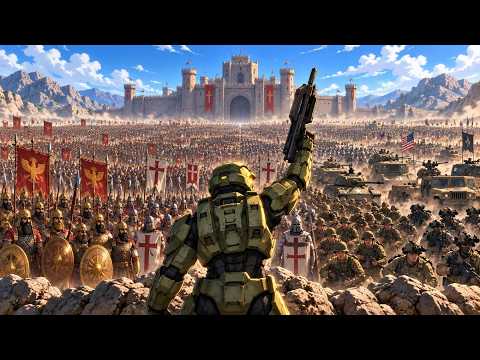
1,000 Vikings vs Bunker Hill: Who Wins and Why
We drop 1,000 Vikings who have never heard a gunshot into the real June 17, 1775 battle and score four stages of the fight.
The Vikings lose the hill; muskets let the British pick the range.
Every NerdHistory fightThe landing and the shield wall
Vikings1,000 Vikings vs Howe's first bayonet charge
The first British charge fails because Howe sends bayonets at a wall that shows no gun barrels. The Vikings stand on the firing step with shields locked and spears out. The 500 bows open at about 200 yards, and the drums keep going while men fall. Howe's light infantry really did attack along the beach in the real battle, so the call isn't crazy.
The mechanism is reach. A 17-inch bayonet on a 5-foot musket lets a redcoat stab from about 6 and a half feet. A Viking ash spear matches or beats that reach, and here it is thrust down from the top of a 6-foot wall. A bearded axe's hooked lower edge also gives a defender a way to hook a musket barrel and pull it aside. The British front rank falls on the spears.
The decisive moment comes when the shield wall starts to fray. A bayonet finds a gap each time a defender stumbles, and the Viking front rank gets chewed up in minutes. Then the berserkers vault the wall. Redcoats had drilled for months to hold formation, but not against a screaming man with a two-handed axe coming over a wall. The first line breaks and runs.
The B reflects what the shield wall can and can't do. Surviving Viking shields are spruce, fir or pine, about 3 feet across and a quarter to half an inch thick. Against blades, weapons stick in the wood. A Brown Bess, a .75-caliber bore firing a .69-caliber lead ball of slightly over an ounce at about 1,000 feet per second, can punch through an inch of pine at range. The wall beat the spears, not the powder, and no musket had fired yet.
Musketry, cannon and the broken ranks
BritishVikings vs British volleys, field guns and Royal Navy
Howe reforms and halts at about 50 yards. The muskets fire together, and at that range a ball ignores shields, mail and courage. The Vikings on the firing step spin and drop. The ships and the battery on Copp's Hill add mostly noise against the dug-in hilltop. Even so, the volleys do the killing.
The Vikings adapt, and the adaptation is smart. The chieftains drop the shield wall and send skirmishers sprinting out to throw spears and hand axes. A volley line is built to hit a block of men, not one man running sideways. The numbers explain why. The smoothbore Brown Bess is accurate to maybe 50 yards against one man, so the British fire volleys. A drilled soldier gets three or four shots a minute. A good archer gets six to 10 arrows in that minute from a bow estimated at 90 pounds of draw.
The arrows pay off hardest in the smoke. As in the real battle, British gunners torch Charlestown with incendiary shot after archers snipe from its houses. Black smoke rolls across the slope, and the archers shoot at shapes moving through the haze. Dozens of redcoats fall before their officers realize they're being hunted. The catch is the quiver. 24 arrows at that pace is about three minutes of shooting.
The berserkers can't take the noise, so a pack follows one howling man over the wall and across open ground. They overrun a gun crew hauling quarter-ton brass guns on drag ropes and hack the carriage apart. In the real battle those guns barely worked, because the gunners had 12-pound balls too fat for their six-pounders. The infantry behind the guns fires at point blank, and most berserkers never return. The arrows are gone and hundreds are dead or wounded. That scores a C: they hurt the British, but only by stepping out from the wall, where muskets rule.
Berserkers, bayonets and the second wave
Vikings (they throw the second wave back)Surviving Vikings vs redcoats, grenadiers and light infantry
We move the tier up from C because this fight is at the one range the Vikings want. With powder spent, the survivors line the wall with axes. The real farmers in this fort ran short of powder. The Vikings carry no powder to run out of. Up close they are better equipped than the men who really held the hill.
The axes beat the bayonets. A surviving berserker's axe hooks a musket behind the blade and rips it away, and the backswing goes through the soldier's shoulder. When grenadiers and light infantry hop the wall, a Viking with a bayonet through his mail still chops off a man's arm at the elbow. A shield and an axe suit that distance better than a 10-pound gun with a knife on the end. Vikings were about 5'8", barely taller than the redcoats, so skill and kit decide the duels, not size.
The line wobbles, and the chieftain decides it. Bleeding from the scalp, he climbs onto the wall and roars, and every Viking who can still stand turns toward him. The line holds. The redcoats that got over are thrown back out, and the second wave slides downhill to reform. A rally where everyone is already half dead holds the wall longer than it should.
The B-minus is capped by biology. Adrenaline and the brain's own opioids quiet pain. In World War II, Dr. Henry Beecher found that far fewer badly wounded soldiers asked for painkillers than surgery patients did. But numb isn't fueled. An all-out swing burns the muscles' instant fuel within seconds, and the backup system fades within a couple of minutes. Lose a large share of your blood and your head fogs, and lose more and you go down. Every duel costs blood the Vikings don't have, and Howe still has fresh men.
The final charge and the last stand
BritishVikings vs Howe's reserves, marines and grapeshot
Howe presses a third assault, as in the real battle: tight columns, reserves and marines thrown in, and the order is bayonets only with no stopping to reload. The field guns switch to grapeshot, canvas bags of plum-sized iron balls that burst like a giant shotgun. The spray sweeps the firing step. The column then hits the redoubt from the left, the right and the middle. A few hundred Vikings stand where a thousand started.
Numbers end it. The shield wall is broken boards, and the dead are piled so high that the redcoats climb them like steps. The first men over wear gold lace, because British officers lead from the front. Major John Pitcairn of the Royal Marines, whose advance guard had been on Lexington Green for the war's first shots two months earlier, is taken by a spear at the top of the wall. In real life it was a musket ball, and who fired it is still debated.
The survivors form a ring in the center of the redoubt and fight with shield pieces and snapped axe handles. For a moment the rush stalls. Then the biology from the last chapter comes due. Arms that have swung all afternoon won't lift an axe past the shoulder, and the men stepping in are fresh. The ring shrinks, one man, then two, then five. The last warrior drops to his knees, and it takes only minutes.
Look at what the Vikings couldn't reach. Howe stands unhurt, and so does his servant with the wine. In the real battle, the farmers' muskets killed or wounded every member of Howe's staff. With the arrows long gone, nothing on the hill can reach that far. The real toll was 1,054 British casualties, mostly from musket fire at around 50 yards. The Vikings could only hurt men inside bow shot or spear reach, and the British chose when that happened. Our estimate is a few hundred redcoats down, probably less than half the farmers' toll. The Vikings lose the hill and every man on it, so the tier is D.
What it comes down to
The Vikings win the first stand and win the melee, but they lose the battle because the British always choose the distance. Shields beat spears, not musket balls. Arrows run out after about three minutes, and berserkers only get one charge. The hill falls after two repulses, as it did in history. Range decided it. The farmers with muskets did more damage than a thousand Vikings could, and that is simply what gunpowder does. Even with a full quiver for each man, the open question, the British would still hold the choice of range.
How we checked it
Every canon and real-world claim on this page was searched and read at the source before it went up. These are the pages we read.
- Bunker Hill Battle Facts and Summary - American Battlefield TrustBritish casualties of 1,054; no firm evidence of who fired the shot that killed Pitcairn
- The Battle of Bunker Hill - Massachusetts Historical SocietyHowe's entire staff was wiped out in the main attack
- Bunker Hill 1775 Part II - WarHistory.org12-pound balls too big for 6-pounders; plum-sized grapeshot in canvas bags; quarter-ton brass guns hauled by drag ropes
- Leidang - WikipediaGulathing-era law: axe or sword, spear and shield per man; a bow and 24 arrows per two-man rowing bench
- The Weight of Viking Shields - Science and FictionSurviving shields are 80-90 cm across, 6-12 mm thick, made of spruce, fir or pine
- A Glossary of Small Arms Across Three Wars - American Battlefield TrustBrown Bess .75 bore, .69 ball, about 10 lb, 17-inch bayonet making a 6.5-foot spear
- Hurstwic: Viking Bow and ArrowOne 10th-century bow estimated at 90 lb draw, effective range about 200 m
- How far is 'musket-shot'? Farther than you think - Journal of the American RevolutionA musket ball passes through a 1-inch pine board
- What did the Vikings REALLY look like? - SkjaldenViking men averaged about 172 cm (about 5'8")
- The Painful Circumstances of Life - Richard E. Simmons IIIBeecher's WWII wounded: about one in four asked for morphine vs about 80% of surgical patients